
For research use only · Not FDA/EMA approved · Not for human consumption
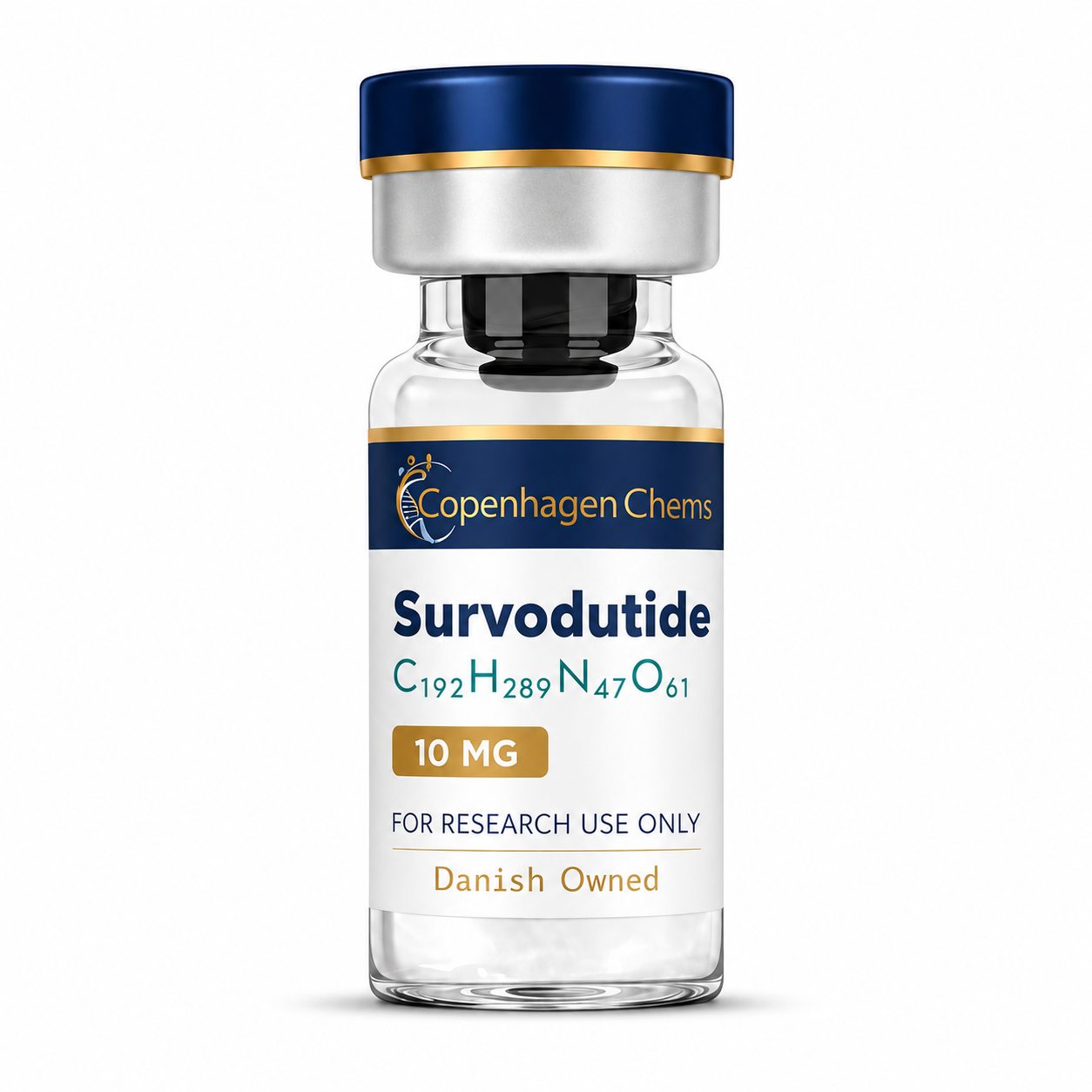
Survodutide
Survodutide (BI 456906)
- CAS Number
- 2805997-46-8
- Molecular Weight
- ≈4232 g/mol
- Molecular Formula
- C₁₉₂H₂₈₉N₄₇O₆₁
Sequence
29-amino-acid linear peptide conjugated to a C18 fatty diacid via a hydrophilic linker at Lys24
Overview
Survodutide (development code BI 456906) is a synthetic peptide developed by Boehringer Ingelheim that activates both the glucagon receptor (GCGR) and the glucagon-like peptide-1 receptor (GLP-1R). Structurally it is a 29-amino-acid linear peptide carrying a C18 fatty diacid moiety attached through a hydrophilic linker at the lysine in position 24, a design intended to extend circulating half-life through albumin binding and permit once-weekly administration in the published trial protocols. It belongs to the same broad investigational class as the triple agonist retatrutide, but engages two receptors rather than three. Published clinical work covers dose-finding in obesity, a head-to-head comparison against semaglutide in type 2 diabetes, and a biopsy-endpoint trial in metabolic dysfunction-associated steatohepatitis (MASH).
For research use only · Not FDA/EMA approved · Not for human consumption
Mechanism of Action
Published pharmacology describes survodutide as a balanced dual agonist at GCGR and GLP-1R. The GLP-1 receptor arm is described in the literature as contributing to satiety signalling, slowed gastric emptying and glucose-dependent insulin secretion, mechanisms shared with the established GLP-1 receptor agonist class. The glucagon receptor arm is the distinguishing feature: published work describes glucagon receptor engagement as increasing energy expenditure and acting on hepatic lipid metabolism, which is the rationale given in the literature for investigating the compound in steatotic liver disease rather than in weight reduction alone. A pharmacological profiling paper published in Diabetes, Obesity and Metabolism sets out the biomarker and receptor-selectivity work used to select the clinical candidate.
For research use only · Not FDA/EMA approved · Not for human consumption
Key Research Areas
- Dose-finding for body-weight reduction in adults with obesity
- Biopsy-confirmed endpoints in metabolic dysfunction-associated steatohepatitis (MASH) and fibrosis
- HbA1c and body-weight response in type 2 diabetes versus semaglutide
- Receptor selectivity and biomarker profiling for candidate selection
- Hepatic lipid metabolism and energy expenditure via glucagon receptor engagement
For research use only · Not FDA/EMA approved · Not for human consumption
Published Studies (4 cited)
| Author | Year | Key Finding | Source |
|---|---|---|---|
| le Roux CW et al. | 2024 | Randomised, double-blind, placebo-controlled dose-finding phase 2 trial of the glucagon/GLP-1 receptor dual agonist survodutide in obesity. | View paper ↗ |
| Sanyal AJ et al. | 2024 | Phase 2 randomised trial of survodutide in MASH and fibrosis, using biopsy-confirmed endpoints. | View paper ↗ |
| Blüher M et al. | 2024 | Randomised trial reporting dose-response effects of survodutide on HbA1c and bodyweight versus placebo and open-label semaglutide in people with type 2 diabetes. | View paper ↗ |
| Thomas L et al. | 2024 | Biomarker and pharmacological profiling of the dual GCGR/GLP-1R agonist survodutide supporting clinical candidate selection. | View paper ↗ |
For research use only · Not FDA/EMA approved · Not for human consumption
Dosage in Published Research
Published clinical trials administered survodutide by subcutaneous injection on a once-weekly schedule, using dose-escalation protocols. The phase 2 obesity dose-finding trial evaluated maintenance doses in the range of approximately 0.6 mg to 4.8 mg weekly following titration. Specific escalation schedules, titration intervals and maintenance doses differ between the obesity, diabetes and MASH protocols. All dosing information here is reported from published clinical literature for reference purposes only and does not constitute a research protocol.
⚠️ Disclaimer: All dosage information is derived exclusively from published scientific literature and is presented for informational reference only. This does not constitute dosing guidance for any application.
For research use only · Not FDA/EMA approved · Not for human consumption
Storage & Handling
Store lyophilized powder at -20°C for long-term storage, protected from light and moisture. Once reconstituted, store at 2–8°C and use within 14 days. Avoid repeated freeze-thaw cycles, which degrade long-chain acylated peptides. Handle under sterile laboratory conditions using appropriate PPE.
For research use only · Not FDA/EMA approved · Not for human consumption
Safety Profile (Literature Only)
Published phase 2 trials report gastrointestinal adverse events — nausea, vomiting and diarrhoea — as the most frequently observed, consistent with the incretin agonist class, with dose-escalation schedules used to mitigate them. Survodutide is an investigational compound: at the time of writing it is not approved by the FDA or EMA for any indication, and the published safety record is limited to the trial populations and durations studied. No safety profile has been established for any use outside those trials. This compound is supplied for laboratory research use only.
For research use only · Not FDA/EMA approved · Not for human consumption
Related Compounds
Retatrutide
A novel triple GIP/GLP-1/glucagon receptor agonist investigated in clinical trials for metabolic research.
LongevityMOTS-c
A mitochondria-derived peptide (MDP) discovered in 2015, investigated for AMPK activation and metabolic regulation in aging research.
Weight LossAOD-9604
A 16-amino-acid fragment corresponding to the C-terminal lipolytic domain of human growth hormone, studied for effects on fat metabolism without the growth-promoting activity of the full hormone.
For research use only · Not FDA/EMA approved · Not for human consumption