
For research use only · Not FDA/EMA approved · Not for human consumption
Selank
Selank (TP-7, Thr-Lys-Pro-Arg-Pro-Gly-Pro)
- CAS Number
- 129954-34-3
- Molecular Weight
- 751.87 g/mol
- Molecular Formula
- C₃₃H₅₇N₁₁O₉
Sequence
Thr-Lys-Pro-Arg-Pro-Gly-Pro
Available in Shop
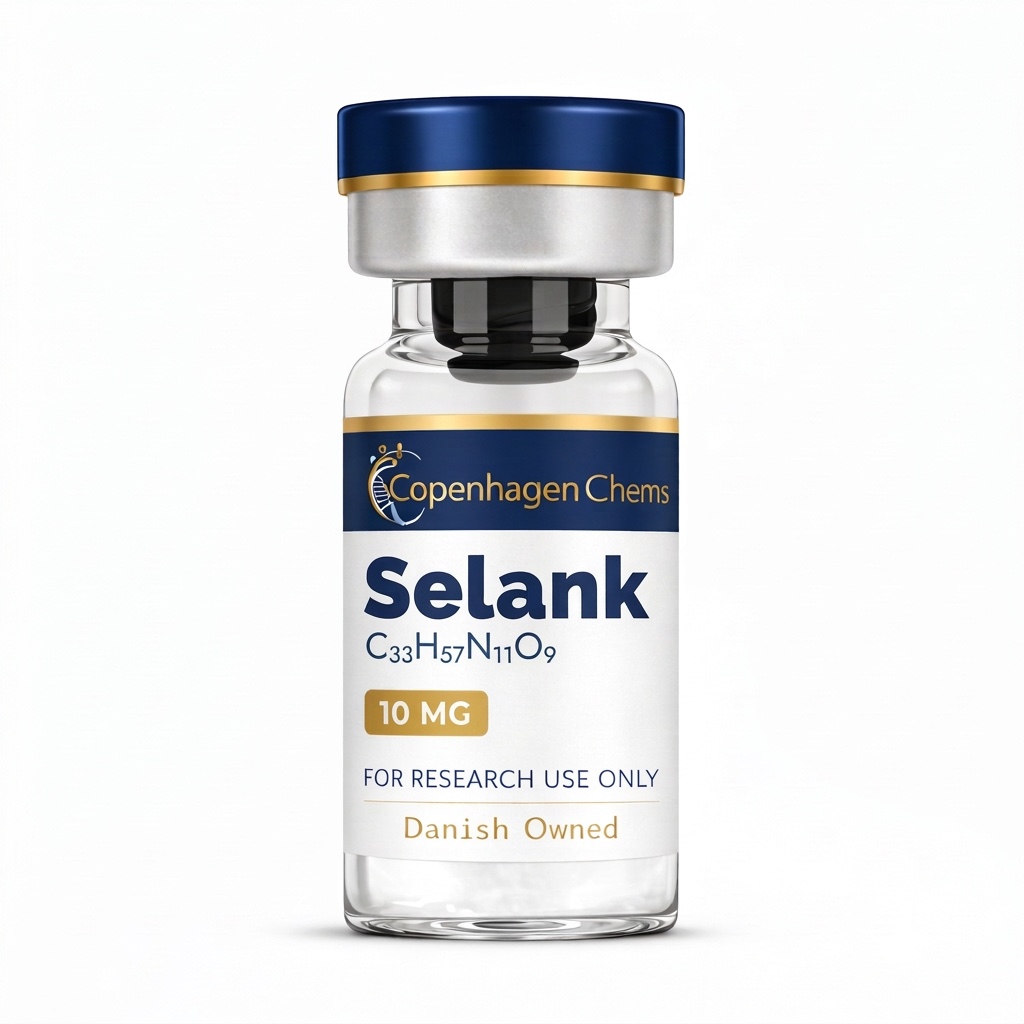
Overview
Selank (TP-7) is a synthetic heptapeptide developed at the Institute of Molecular Genetics of the Russian Academy of Sciences, structurally based on the naturally occurring immunomodulatory peptide tuftsin (Thr-Lys-Pro-Arg) with an added Pro-Gly-Pro sequence for enhanced stability and CNS activity. Selank has been approved in Russia as an anxiolytic and nootropic agent. Published research describes its unique profile combining anxiolytic effects (comparable to benzodiazepines in some animal models) without sedative, amnestic, or dependence-producing properties. The peptide has been investigated for its dual immunomodulatory and neurotropic mechanisms, distinguishing it from classical anxiolytic compounds.
For research use only · Not FDA/EMA approved · Not for human consumption
Mechanism of Action
Published research describes Selank as modulating GABAergic neurotransmission through allosteric interactions with GABA-A receptors, enhancing inhibitory signaling in limbic structures. Studies describe modulation of monoamine neurotransmitter systems including serotonin, norepinephrine, and dopamine. The peptide influences BDNF expression and enkephalin metabolism through inhibition of enkephalin-degrading enzymes, potentially contributing to its anxiolytic profile. As a tuftsin analog, Selank retains immunomodulatory properties including effects on IL-6, IFN-α/γ, and other cytokines. Gene expression studies describe modulation of inflammatory, chemokine, and neurotrophic gene networks.
For research use only · Not FDA/EMA approved · Not for human consumption
Key Research Areas
- Anxiolytic effects in behavioral models without sedation or dependence
- GABAergic modulation and benzodiazepine-site interactions
- Immunomodulatory properties through tuftsin-related mechanisms
- BDNF and enkephalin pathway modulation in CNS tissue
- Gene expression changes in limbic and cortical brain regions
- Cognitive function and attention in experimental paradigms
For research use only · Not FDA/EMA approved · Not for human consumption
Published Studies (6 cited)
| Author | Year | Key Finding | Source |
|---|---|---|---|
| Kolomin T et al. | 2011 | The tuftsin analogue Selank altered expression of inflammation-related genes in mouse spleen. | View paper ↗ |
| Konstantinopolsky MA et al. | 2022 | Selank attenuated aversive signs of morphine withdrawal in rats, consistent with its described anxiolytic profile. | View paper ↗ |
| Kolomin T et al. | 2014 | Transcriptomic analysis revealed Selank modulated expression of 36 genes involved in GABAergic signaling and neurotransmitter pathways in hippocampus. | View paper ↗ |
| Kozlovskii II, Danchev ND | 2003 | Selank improved performance on a conditioned active avoidance task in rats, indicating an effect on learning and memory. | View paper ↗ |
| Filatova E et al. | 2017 | Selank altered expression of genes involved in GABAergic neurotransmission in rat brain, alongside GABA and olanzapine. | View paper ↗ |
| Kolik LG et al. | 2019 | Selank protected against ethanol-induced memory impairment in rats, linked to regulation of monoamine and GABAergic signalling. | View paper ↗ |
For research use only · Not FDA/EMA approved · Not for human consumption
Dosage in Published Research
Published animal studies have administered Selank intranasally at doses of 100–300 μg/kg in rodent models. Clinical use in Russia employs 0.15% nasal drops (approximately 75 μg per drop). In vitro studies have used concentrations of 10 nM to 100 μM. All dosing information is from published literature only.
⚠️ Disclaimer: All dosage information is derived exclusively from published scientific literature and is presented for informational reference only. This does not constitute dosing guidance for any application.
For research use only · Not FDA/EMA approved · Not for human consumption
Storage & Handling
Store lyophilized Selank at -20°C. Reconstituted solutions at 2–8°C, use within 14 days. Protect from light and moisture. Handle with sterile laboratory technique.
For research use only · Not FDA/EMA approved · Not for human consumption
Safety Profile (Literature Only)
Selank has been approved for clinical use in Russia with an established post-marketing safety record. Published studies describe no sedation, no physical dependence, no withdrawal effects, and no amnestic properties—distinguishing it from benzodiazepines. No significant adverse effects have been reported in published preclinical studies. This compound is for laboratory research use only.
For research use only · Not FDA/EMA approved · Not for human consumption
Related Compounds
NAD+
An essential coenzyme present in all living cells, investigated for its declining levels with age and role in sirtuin-mediated longevity pathways.
NootropicsSemax
A synthetic heptapeptide analog of ACTH(4-10) developed in Russia, researched for neurotrophic and neuroprotective properties.
LongevityEpithalon
A synthetic tetrapeptide based on epithalamin, studied for telomerase activation and circadian rhythm modulation in aging research.
Further reading on Selank
- Semax vs Selank for Nootropic Research — side-by-side comparison
- Neuropeptides in Cognitive and Neuroscience Research — 7 min
For research use only · Not FDA/EMA approved · Not for human consumption