
For research use only · Not FDA/EMA approved · Not for human consumption
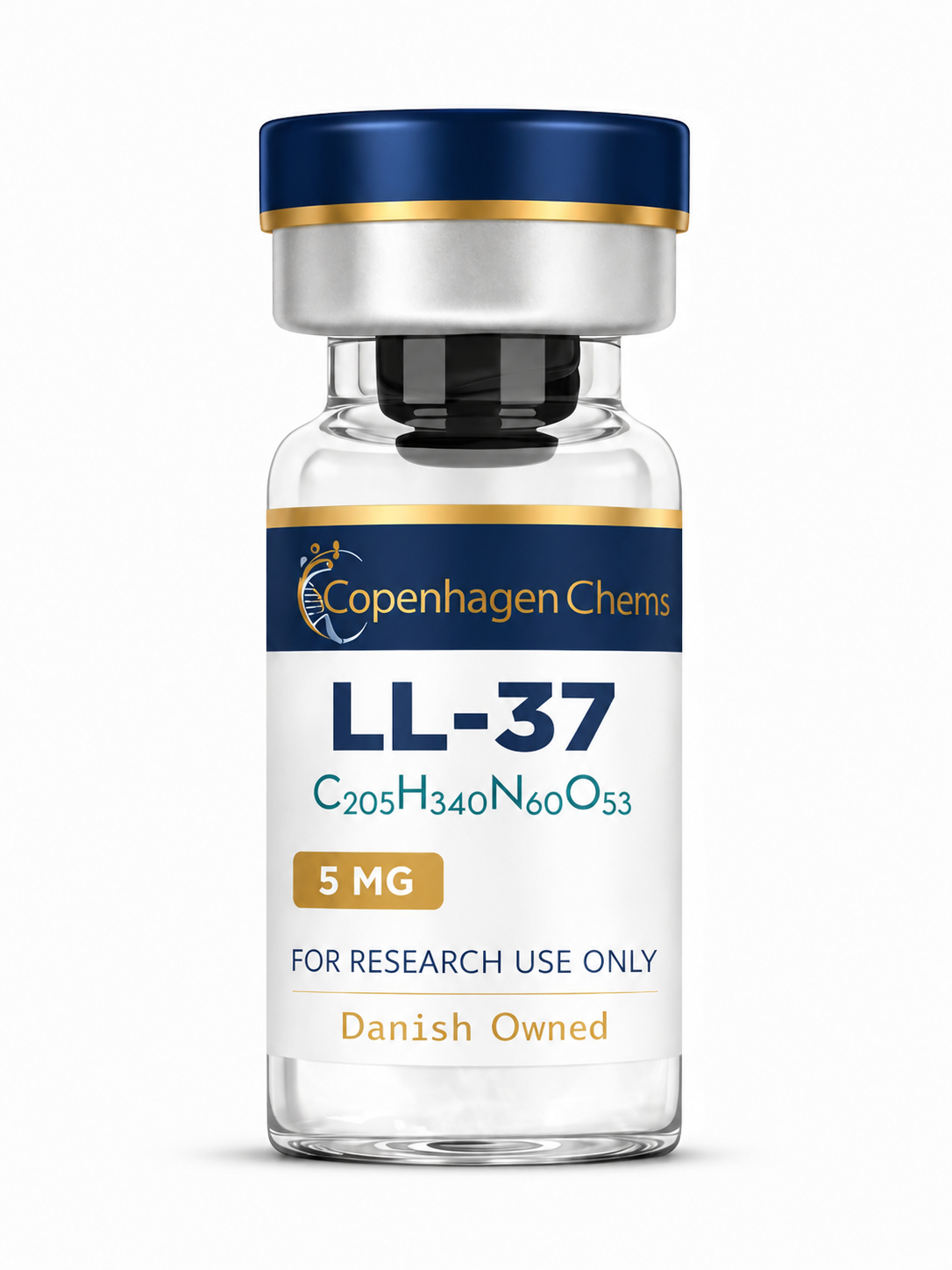
LL-37
LL-37 (human cathelicidin antimicrobial peptide, hCAP18 fragment)
- CAS Number
- 154947-66-7
- Molecular Weight
- ≈4493 g/mol
- Molecular Formula
- C₂₀₅H₃₄₀N₆₀O₅₃
Sequence
37 amino acids; the C-terminal fragment released from hCAP18
Overview
LL-37 is the sole cathelicidin-family antimicrobial peptide found in humans. It is released by proteolytic cleavage from the precursor protein hCAP18 and takes its name from the two leucine residues at its N-terminus followed by its 37-residue length. It adopts an amphipathic alpha-helical conformation, a structural feature common to many cationic antimicrobial peptides and central to its proposed membrane-directed mechanism. The published literature describes it as a multifunctional peptide: alongside direct antimicrobial activity it is studied for immunomodulatory signalling and roles in tissue repair. Notably, the literature also examines contexts in which LL-37 activity appears detrimental rather than beneficial, including its interaction with amyloid-forming proteins.
For research use only · Not FDA/EMA approved · Not for human consumption
Mechanism of Action
Published research describes LL-37 as cationic and amphipathic, allowing it to associate with negatively charged bacterial membranes and disrupt membrane integrity — the direct antimicrobial mechanism. Beyond this, the literature describes receptor-mediated immunomodulatory actions, including signalling through formyl peptide receptor 2 (FPR2), with reported effects on chemotaxis of immune cells, cytokine responses and angiogenesis. Published work on wound repair describes effects on keratinocyte migration and re-epithelialisation, and a 2024 study in diabetic mice reported a mechanism involving TFEB-dependent autophagy. A separate strand of published work characterises LL-37's influence on amyloid aggregation, which is examined as a potential pathological interaction rather than a therapeutic one.
For research use only · Not FDA/EMA approved · Not for human consumption
Key Research Areas
- Direct antimicrobial activity against bacteria and biofilms
- Wound healing and re-epithelialisation in preclinical models
- Immunomodulatory signalling via formyl peptide receptor 2
- Structure-function relationships of the amphipathic helix
- Interaction with amyloid-related disease processes
For research use only · Not FDA/EMA approved · Not for human consumption
Published Studies (4 cited)
| Author | Year | Key Finding | Source |
|---|---|---|---|
| Xi L et al. | 2024 | Cathelicidin LL-37 promoted wound healing in diabetic mice through regulation of TFEB-dependent autophagy. | View paper ↗ |
| Saporito P et al. | 2018 | LL-37 fragments showed antimicrobial activity against Staphylococcus epidermidis biofilms and wound healing potential in the HaCaT keratinocyte cell line. | View paper ↗ |
| Bandurska K et al. | 2015 | Review of the structural and functional features distinguishing human cathelicidin LL-37. | View paper ↗ |
| Bhattacharjya S et al. | 2024 | Review of LL-37 structures, antimicrobial activity and influence on amyloid-related diseases. | View paper ↗ |
For research use only · Not FDA/EMA approved · Not for human consumption
Dosage in Published Research
The published literature on LL-37 is predominantly in vitro and preclinical. Antimicrobial and cell-culture studies report activity at micromolar concentrations, with minimum inhibitory concentrations varying by organism, by assay conditions and notably by salt concentration, which published work identifies as strongly influencing activity. Animal wound-healing studies have used topical application protocols. No standardised dosing protocol exists. All figures are reported from published literature for reference purposes only.
⚠️ Disclaimer: All dosage information is derived exclusively from published scientific literature and is presented for informational reference only. This does not constitute dosing guidance for any application.
For research use only · Not FDA/EMA approved · Not for human consumption
Storage & Handling
Store lyophilized powder at -20°C for long-term storage, protected from light and moisture. Once reconstituted, store at 2–8°C and use within 14 days. As a cationic peptide, LL-37 adsorbs to some plastic surfaces; low-binding labware is used in published protocols. Activity is described in the literature as salt-sensitive, so buffer composition matters. Avoid repeated freeze-thaw cycles. Handle under sterile laboratory conditions using appropriate PPE.
For research use only · Not FDA/EMA approved · Not for human consumption
Safety Profile (Literature Only)
Published in vitro work describes concentration-dependent cytotoxicity toward mammalian cells at higher concentrations, and haemolytic activity has been characterised as part of the structure-function literature on cationic amphipathic peptides. The published record is largely in vitro and preclinical; no human clinical safety profile is established. This compound is supplied for laboratory research use only.
For research use only · Not FDA/EMA approved · Not for human consumption
Related Compounds
BPC-157
A pentadecapeptide derived from human gastric juice, extensively studied for tissue-protective properties in animal models.
Skin & TissueGHK-Cu
A naturally occurring copper-binding tripeptide studied for its role in tissue remodeling, wound repair, and gene expression modulation.
RecoveryTB-500
A synthetic fragment of thymosin beta-4 researched for actin-binding properties and tissue repair mechanisms in preclinical models.
For research use only · Not FDA/EMA approved · Not for human consumption