
For research use only · Not FDA/EMA approved · Not for human consumption
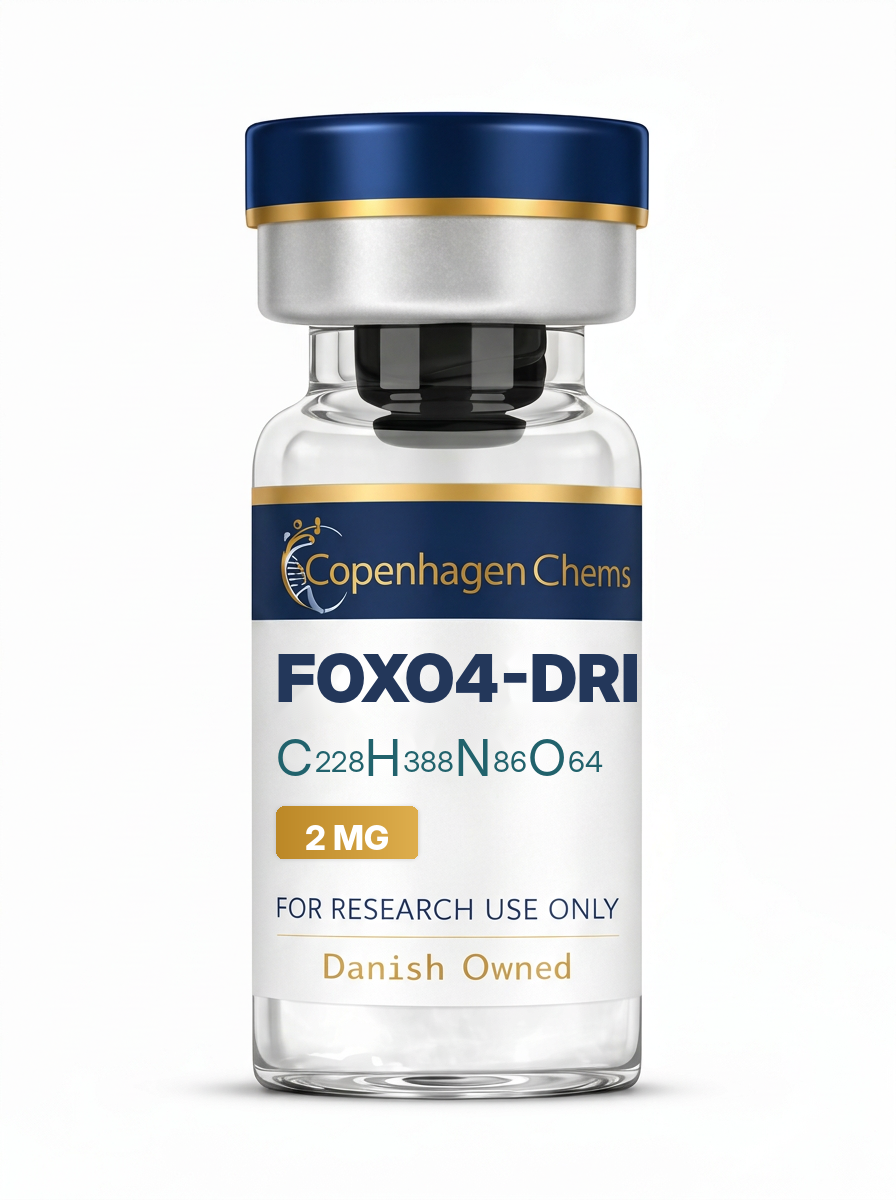
FOXO4-DRI
FOXO4 D-Retro-Inverso peptide (FOXO4-DRI)
- CAS Number
- 2460055-10-9
- Molecular Weight
- ≈5358 g/mol
- Molecular Formula
- C₂₂₈H₃₈₈N₈₆O₆₄
Sequence
Retro-inverso peptide composed of D-amino acids in reversed sequence order
Overview
FOXO4-DRI is a synthetic peptide built on the D-retro-inverso principle: it is assembled from D-amino acids in reversed sequence order, a design that approximates the side-chain topology of the corresponding L-peptide while conferring substantial resistance to proteolytic degradation. It was developed as a senolytic — a compound intended to eliminate senescent cells selectively — by disrupting a specific protein interaction on which senescent cells are proposed to depend for their viability. It is a research tool compound rather than a clinical agent; the published literature is preclinical, comprising cell and animal work together with structural biology characterising its target interaction.
For research use only · Not FDA/EMA approved · Not for human consumption
Mechanism of Action
Published research describes FOXO4-DRI as interfering with the interaction between the transcription factor FOXO4 and the tumour suppressor p53. In senescent cells, FOXO4 is described as sequestering p53 in the nucleus, preventing p53-mediated apoptosis and thereby permitting the senescent cell to persist. FOXO4-DRI is designed to compete with that interaction, releasing p53 and allowing apoptosis to proceed in senescent cells while sparing non-senescent ones. A 2025 structural study in Nature Communications identified the disordered p53 transactivation domain as the target of both FOXO4 and FOXO4-DRI, providing a molecular account of the interaction. Published work in keloid fibroblasts describes an apoptotic mechanism involving nuclear exclusion of p53 phosphorylated at serine 15.
For research use only · Not FDA/EMA approved · Not for human consumption
Key Research Areas
- Selective elimination of senescent cells in vitro and in animal models
- Structural characterisation of the FOXO4–p53 interaction
- Apoptosis in senescent keloid fibroblasts
- Context-dependent consequences of senolysis, including adverse outcomes
- Retro-inverso peptide design and proteolytic stability
For research use only · Not FDA/EMA approved · Not for human consumption
Published Studies (4 cited)
| Author | Year | Key Finding | Source |
|---|---|---|---|
| Bourgeois B et al. | 2025 | Identified the disordered p53 transactivation domain as the target of FOXO4 and of the senolytic compound FOXO4-DRI. | View paper ↗ |
| Kong YX et al. | 2025 | FOXO4-DRI induced apoptosis in keloid senescent fibroblasts by promoting nuclear exclusion of upregulated p53-serine 15 phosphorylation. | View paper ↗ |
| Born E et al. | 2023 | Reported that eliminating senescent cells can promote the development and progression of pulmonary hypertension — evidence that senolysis is not uniformly beneficial and is context-dependent. | View paper ↗ |
| Alameen AAM et al. | 2026 | Reviewed targeting of the FOXO4-p53 axis by retro-inverso peptide senolytic agents in the context of brain aging and cognitive decline. | View paper ↗ |
For research use only · Not FDA/EMA approved · Not for human consumption
Dosage in Published Research
The published literature on FOXO4-DRI is preclinical. Cell culture studies report use at micromolar concentrations, and published animal work has used intraperitoneal administration on intermittent rather than continuous schedules, reflecting the senolytic strategy of periodic clearance. Protocols differ substantially between studies and models. No standardised protocol exists, and no human dosing data is available. All figures are reported from published literature for reference purposes only.
⚠️ Disclaimer: All dosage information is derived exclusively from published scientific literature and is presented for informational reference only. This does not constitute dosing guidance for any application.
For research use only · Not FDA/EMA approved · Not for human consumption
Storage & Handling
Store lyophilized powder at -20°C for long-term storage, protected from light and moisture. Once reconstituted, store at 2–8°C and use within 14 days. The D-retro-inverso construction confers greater proteolytic stability than a conventional L-peptide, but this does not remove the need for cold storage or protection from freeze-thaw cycling. Handle under sterile laboratory conditions using appropriate PPE.
For research use only · Not FDA/EMA approved · Not for human consumption
Safety Profile (Literature Only)
No human clinical data exists for FOXO4-DRI and no LD50 has been established. The published preclinical record includes an important qualification that any honest summary must carry: senolytic clearance of senescent cells has been reported to worsen outcomes in at least one disease model, with published work in Circulation describing promotion of pulmonary hypertension. Senescent cells are understood in the literature to have context-dependent roles, including in wound repair. This compound is supplied for laboratory research use only.
For research use only · Not FDA/EMA approved · Not for human consumption
Related Compounds
NAD+
An essential coenzyme present in all living cells, investigated for its declining levels with age and role in sirtuin-mediated longevity pathways.
LongevityMOTS-c
A mitochondria-derived peptide (MDP) discovered in 2015, investigated for AMPK activation and metabolic regulation in aging research.
LongevityEpithalon
A synthetic tetrapeptide based on epithalamin, studied for telomerase activation and circadian rhythm modulation in aging research.
For research use only · Not FDA/EMA approved · Not for human consumption