
For research use only · Not FDA/EMA approved · Not for human consumption
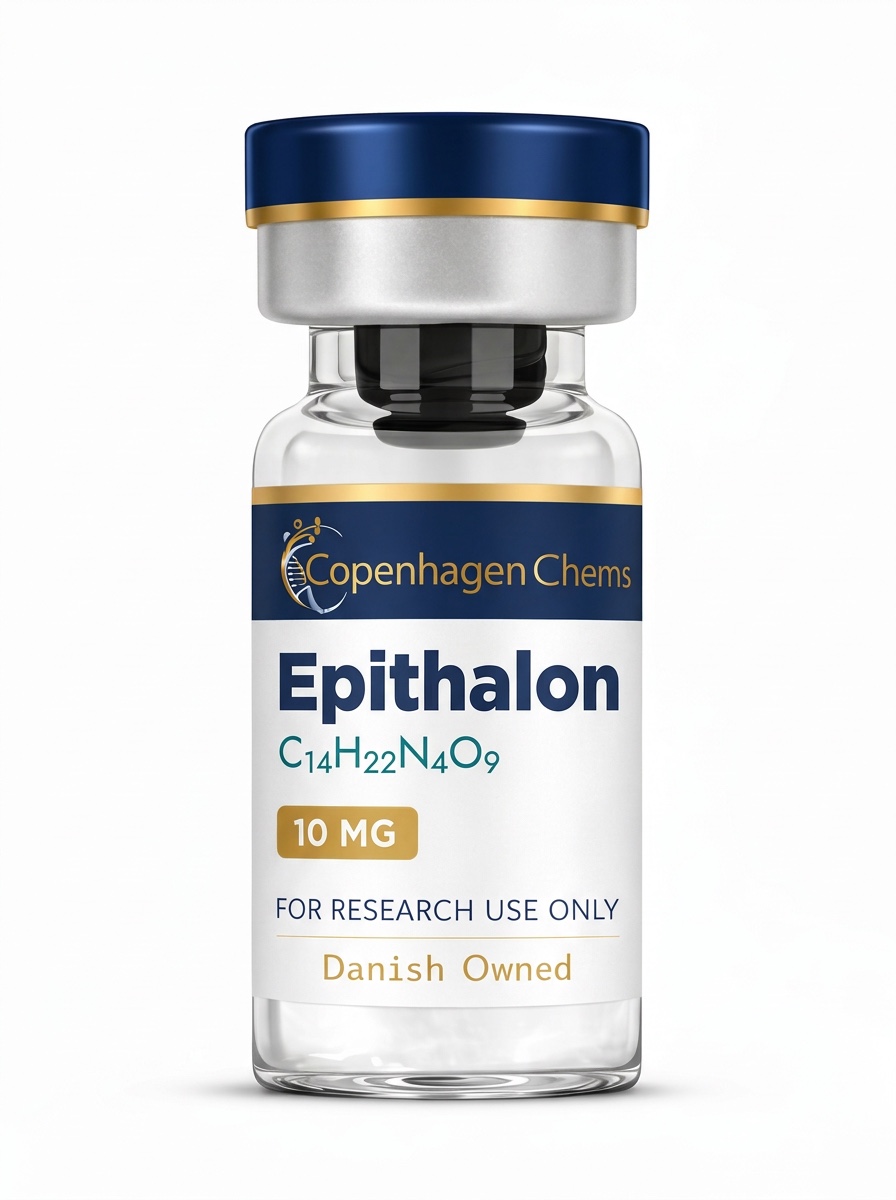
Epithalon
Epithalon (Epitalon, Epithalone, AGAG)
- CAS Number
- 307297-39-8
- Molecular Weight
- 390.35 g/mol
- Molecular Formula
- C₁₄H₂₂N₄O₉
Sequence
Ala-Glu-Asp-Gly
Available in Shop
Overview
Epithalon (also known as Epitalon or Epithalone) is a synthetic tetrapeptide (Ala-Glu-Asp-Gly) developed by Professor Vladimir Khavinson at the Saint Petersburg Institute of Bioregulation and Gerontology. It is a synthetic version of a naturally occurring pineal gland peptide called epithalamin. Published research spanning over three decades has investigated Epithalon's effects on telomerase activation, melatonin production, and various biomarkers of aging. The compound belongs to a class of bioregulatory peptides (Khavinson peptides) theorized to interact with specific gene promoter regions and modulate gene expression in age-dependent pathways.
For research use only · Not FDA/EMA approved · Not for human consumption
Mechanism of Action
Published research describes Epithalon as activating telomerase through induction of the catalytic subunit hTERT (human telomerase reverse transcriptase). Studies have demonstrated increased telomerase activity in somatic cells, potentially counteracting telomere shortening associated with cellular aging. Additional mechanisms described in literature include modulation of melatonin synthesis in the pineal gland through effects on serotonin N-acetyltransferase, regulation of circadian neuroendocrine function, and modulation of antioxidant enzyme expression including superoxide dismutase and glutathione peroxidase. The tetrapeptide is proposed to interact with DNA at specific promoter regions, influencing transcription of age-related genes.
For research use only · Not FDA/EMA approved · Not for human consumption
Key Research Areas
- Telomerase activation and telomere length maintenance in human cell cultures
- Melatonin secretion regulation and circadian rhythm normalization in aged animals
- Lifespan studies in various model organisms
- Antioxidant enzyme expression in aging tissue models
- Pineal gland function and neuroendocrine aging
- Retinal cell protection and age-related retinal degeneration models
For research use only · Not FDA/EMA approved · Not for human consumption
Published Studies (5 cited)
| Author | Year | Key Finding | Source |
|---|---|---|---|
| Khavinson VKh et al. | 2003 | Epithalon activated telomerase in human somatic cells, increasing telomerase activity by 2.4-fold in pulmonary fibroblast cultures. | View paper ↗ |
| Rosenfeld SV et al. | 2002 | Epithalon reduced the incidence of chromosome aberrations in senescence-accelerated mice. | View paper ↗ |
| Anisimov VN et al. | 2002 | Epithalon inhibited tumour growth and reduced HER-2/neu oncogene expression in mammary tumours in transgenic mice. | View paper ↗ |
| Goncharova ND et al. | 2001 | Epithalon influenced melatonin and cortisol production in old monkeys, restoring a more youthful daily rhythm. | View paper ↗ |
| Khavinson VKh et al. | 2003 | Epithalon peptide induced telomerase activity and telomere elongation in human somatic cells in culture. | View paper ↗ |
For research use only · Not FDA/EMA approved · Not for human consumption
Dosage in Published Research
Published animal studies have administered Epithalon at doses of 0.1–10 μg per animal via subcutaneous or intraperitoneal injection in rodent models, typically in courses of 10–20 days. Primate studies used similar dose ranges adjusted for body weight. Clinical observational studies with epithalamin used 10 mg intramuscularly in 10-day courses. All dosing information is from published literature only.
⚠️ Disclaimer: All dosage information is derived exclusively from published scientific literature and is presented for informational reference only. This does not constitute dosing guidance for any application.
For research use only · Not FDA/EMA approved · Not for human consumption
Storage & Handling
Store lyophilized Epithalon at -20°C protected from light and moisture. Reconstituted solutions at 2–8°C, use within 14 days. The tetrapeptide is relatively stable but should be handled with sterile technique.
For research use only · Not FDA/EMA approved · Not for human consumption
Safety Profile (Literature Only)
Published studies including long-term observation studies (up to 6 years) have described Epithalon and epithalamin as well-tolerated with no significant adverse effects reported at investigated doses. The tetrapeptide has a long research history in Russian biogerontology. However, large-scale controlled clinical trials meeting Western regulatory standards have not been published. This compound is for laboratory research use only.
For research use only · Not FDA/EMA approved · Not for human consumption
Related Compounds
GHK-Cu
A naturally occurring copper-binding tripeptide studied for its role in tissue remodeling, wound repair, and gene expression modulation.
LongevityNAD+
An essential coenzyme present in all living cells, investigated for its declining levels with age and role in sirtuin-mediated longevity pathways.
LongevityMOTS-c
A mitochondria-derived peptide (MDP) discovered in 2015, investigated for AMPK activation and metabolic regulation in aging research.
For research use only · Not FDA/EMA approved · Not for human consumption