
For research use only · Not FDA/EMA approved · Not for human consumption
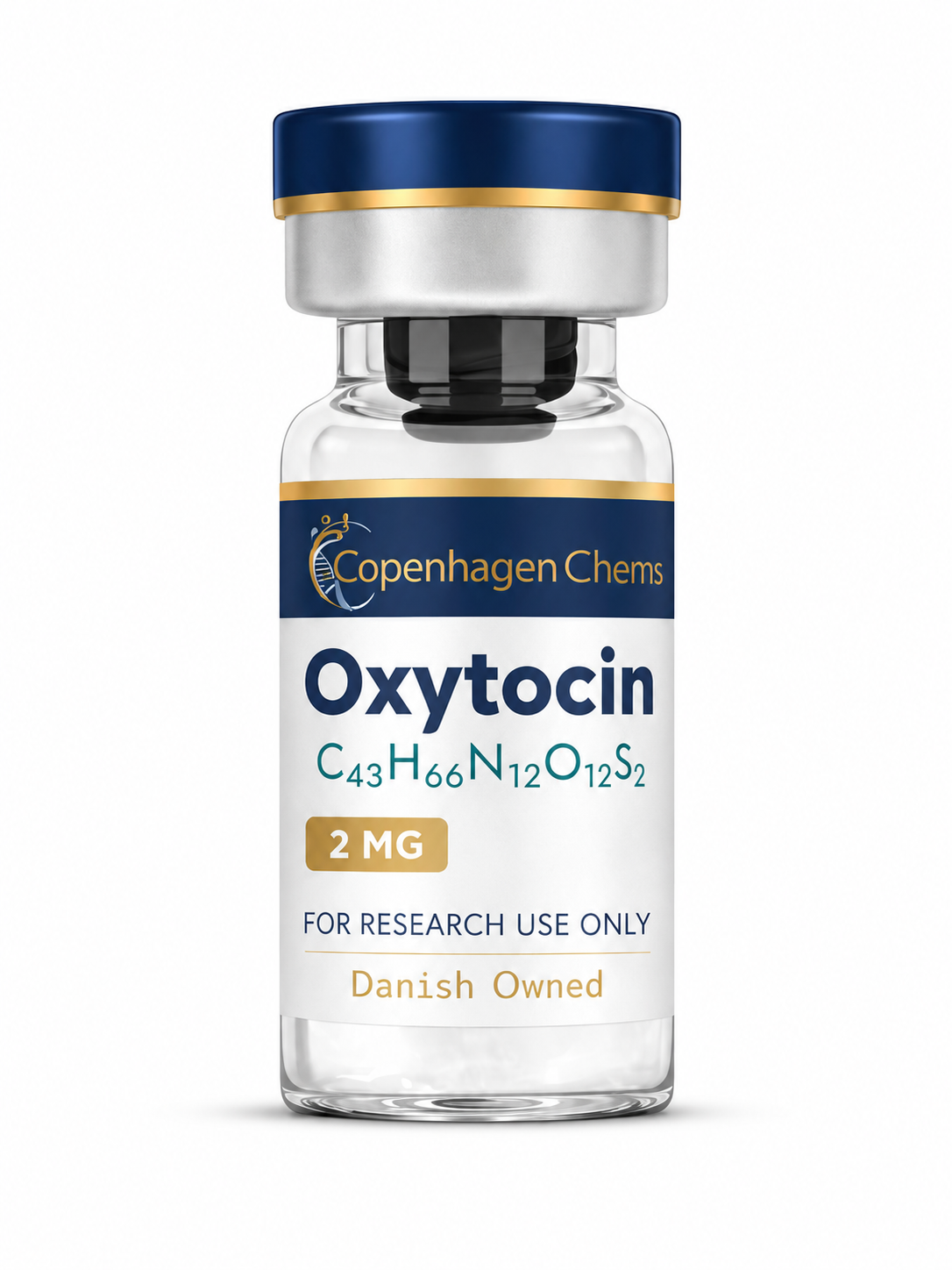
Oxytocin
Oxytocin
- CAS Number
- 50-56-6
- Molecular Weight
- 1007.19 g/mol
- Molecular Formula
- C₄₃H₆₆N₁₂O₁₂S₂
Sequence
Cys-Tyr-Ile-Gln-Asn-Cys-Pro-Leu-Gly-NH₂ (disulfide bridge Cys1–Cys6)
Overview
Oxytocin is a nonapeptide produced in the hypothalamus and released from the posterior pituitary. It contains a characteristic disulfide bridge between the cysteine residues at positions 1 and 6, forming a six-residue ring with a three-residue tail. Beyond its long-established peripheral roles, oxytocin has been the subject of a large experimental literature in which it is administered intranasally to human volunteers and its effects on social cognition, emotion recognition and related behavioural measures are assessed. This literature is notable for being unusually contested: early positive findings have been followed by null results, failed replications and meta-analyses that report much smaller effects than the initial studies suggested. Any honest summary has to present that disagreement rather than only the positive findings.
For research use only · Not FDA/EMA approved · Not for human consumption
Mechanism of Action
Oxytocin acts at the oxytocin receptor (OXTR), a G-protein coupled receptor, and shows cross-reactivity at vasopressin receptors owing to the close structural similarity between the two nonapeptides. Published research describes central effects mediated through oxytocin receptor populations in the amygdala, hippocampus and striatum, with proposed downstream modulation of dopaminergic and serotonergic signalling. A significant methodological question runs through the intranasal literature and is discussed openly in it: the extent to which intranasally administered oxytocin reaches central receptor populations at behaviourally relevant concentrations remains debated, and this uncertainty is one of the proposed explanations for the inconsistency of published behavioural results.
For research use only · Not FDA/EMA approved · Not for human consumption
Key Research Areas
- Intranasal administration and social cognition in healthy volunteers
- Facial emotion recognition paradigms
- Meta-analysis of effects in neurodevelopmental conditions
- Dose-response relationships in experimental administration
- Null and failed-replication findings as part of the published record
For research use only · Not FDA/EMA approved · Not for human consumption
Published Studies (4 cited)
| Author | Year | Key Finding | Source |
|---|---|---|---|
| Keech B et al. | 2018 | Meta-analysis of intranasal oxytocin and social cognition in neurodevelopmental disorders. | View paper ↗ |
| Ellenbogen MA | 2018 | Review of the experimental literature on oxytocin and facial emotion recognition. | View paper ↗ |
| Grainger SA et al. | 2018 | Reported that intranasal oxytocin did not reduce age-related difficulties in social cognition — a null result within this literature. | View paper ↗ |
| Barton S et al. | 2025 | Systematic review of dose-response effects of exogenous oxytocin on social cognition. | View paper ↗ |
For research use only · Not FDA/EMA approved · Not for human consumption
Dosage in Published Research
Published human experimental studies have most commonly administered oxytocin intranasally at 24 IU, with a substantial minority of studies using 12 IU, 32 IU or 40 IU, typically 30–45 minutes before behavioural testing. A 2025 systematic review specifically examined whether a dose-response relationship is discernible across this literature. Dosing varies considerably by paradigm and no standard research protocol exists. All figures are reported from published literature for reference purposes only.
⚠️ Disclaimer: All dosage information is derived exclusively from published scientific literature and is presented for informational reference only. This does not constitute dosing guidance for any application.
For research use only · Not FDA/EMA approved · Not for human consumption
Storage & Handling
Store lyophilized powder at -20°C for long-term storage, protected from light and moisture. Once reconstituted, store at 2–8°C and use within 14 days. Oxytocin contains a disulfide bridge that is sensitive to reducing agents and to repeated freeze-thaw cycles. Handle under sterile laboratory conditions using appropriate PPE.
For research use only · Not FDA/EMA approved · Not for human consumption
Safety Profile (Literature Only)
In the published intranasal experimental literature, single-dose administration in healthy adult volunteers has generally been reported as well tolerated, with headache and nasal irritation among the effects noted. The published record concerns short-term experimental administration; effects of repeated or long-term administration in this setting are not well characterised in the literature. This compound is supplied for laboratory research use only and is not for human consumption.
For research use only · Not FDA/EMA approved · Not for human consumption
Related Compounds
Semax
A synthetic heptapeptide analog of ACTH(4-10) developed in Russia, researched for neurotrophic and neuroprotective properties.
NootropicsSelank
A synthetic heptapeptide analog of immunomodulatory tuftsin, researched for anxiolytic and nootropic properties without sedation.
HormonesKisspeptin-10
The ten-residue C-terminal fragment of kisspeptin, studied in human physiology as an upstream regulator of GnRH release.
For research use only · Not FDA/EMA approved · Not for human consumption