
For research use only · Not FDA/EMA approved · Not for human consumption
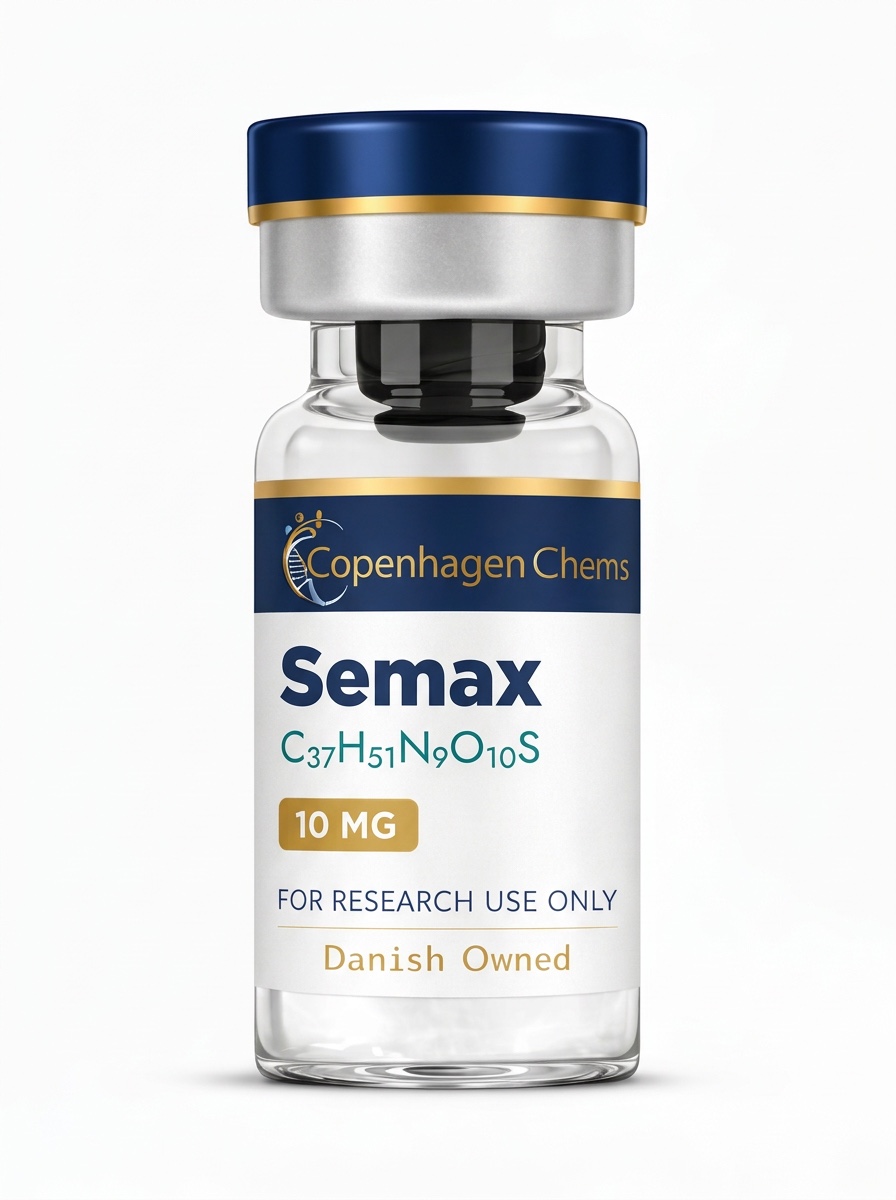
Semax
Semax (MEHFPGP, Heptapeptide)
- CAS Number
- 80714-61-0
- Molecular Weight
- 813.93 g/mol
- Molecular Formula
- C₃₇H₅₁N₉O₁₀S
Sequence
Met-Glu-His-Phe-Pro-Gly-Pro
Available in Shop
Overview
Semax is a synthetic heptapeptide based on the structure of adrenocorticotropic hormone (ACTH) fragment 4–10 (Met-Glu-His-Phe-Pro-Gly-Pro). It was developed at the Institute of Molecular Genetics of the Russian Academy of Sciences and has been approved as a nootropic and neuroprotective agent in Russia and several CIS countries since 1994. Semax is structurally modified from the native ACTH(4-10) fragment to resist enzymatic degradation while retaining neurotrophic activity without hormonal (corticosteroid-stimulating) effects. Published research describes its effects on brain-derived neurotrophic factor (BDNF) expression, cognitive function in various experimental paradigms, and neuroprotection in models of ischemic brain injury.
For research use only · Not FDA/EMA approved · Not for human consumption
Mechanism of Action
Published research describes Semax as modulating the expression of neurotrophins, particularly BDNF and NGF (nerve growth factor), through activation of TrkB receptors and downstream signaling cascades including PI3K/Akt and MAPK/ERK pathways. Studies describe its effects on dopaminergic, serotonergic, and cholinergic neurotransmitter systems. The peptide has been shown to modulate expression of genes involved in neurovascular unit function, immune response in the CNS, and oxidative stress defense. Its melanocortin receptor-independent mechanisms distinguish it from other ACTH-derived peptides.
For research use only · Not FDA/EMA approved · Not for human consumption
Key Research Areas
- BDNF and NGF modulation in CNS tissue models
- Neuroprotection in experimental ischemic stroke models
- Cognitive function and memory in behavioral paradigms
- Gene expression profiling in brain tissue after administration
- Attention and learning in various experimental models
- Optic nerve disease and retinal ganglion cell protection
For research use only · Not FDA/EMA approved · Not for human consumption
Published Studies (5 cited)
| Author | Year | Key Finding | Source |
|---|---|---|---|
| Agapova TY et al. | 2008 | Semax increased BDNF expression in rat brain hippocampus and cortex following intranasal administration. | View paper ↗ |
| Medvedeva EV et al. | 2017 | Transcriptomic analysis showed Semax, an ACTH(4-7) analogue, altered expression of immune-response genes in rat brain after ischemic injury. | View paper ↗ |
| Grivennikov IA et al. | 2008 | Semax, an ACTH(4-10) analogue, affected survival and differentiation of rat basal forebrain cholinergic neurons in culture. | View paper ↗ |
| Inozemtsev AN et al. | 2015 | Semax influenced formation of an active avoidance response in rats and protected against its functional impairment. | View paper ↗ |
| Shadrina M et al. | 2009 | Semax altered the temporal dynamics of NGF and BDNF gene expression in rat hippocampus and frontal cortex. | View paper ↗ |
For research use only · Not FDA/EMA approved · Not for human consumption
Dosage in Published Research
Published studies have administered Semax intranasally at doses of 50–600 μg/kg in rodent models. Clinical use in Russia employs 0.1% nasal drops. In vitro studies have used concentrations of 1–100 μM. The intranasal route is preferred in published research due to enhanced CNS bioavailability. All dosing information is from published literature only.
⚠️ Disclaimer: All dosage information is derived exclusively from published scientific literature and is presented for informational reference only. This does not constitute dosing guidance for any application.
For research use only · Not FDA/EMA approved · Not for human consumption
Storage & Handling
Store lyophilized Semax at -20°C. Reconstituted solutions at 2–8°C, use within 14 days. The peptide contains methionine and is sensitive to oxidation. Store under inert atmosphere when possible. Protect from light.
For research use only · Not FDA/EMA approved · Not for human consumption
Safety Profile (Literature Only)
Semax has been approved for clinical use in Russia since 1994 and has an established post-marketing safety record in that regulatory context. Published studies describe a favorable tolerability profile with no significant adverse effects at investigated doses. No hormonal (corticosteroid-stimulating) activity has been reported. Western regulatory approval has not been sought. This compound is for laboratory research use only.
For research use only · Not FDA/EMA approved · Not for human consumption
Related Compounds
NAD+
An essential coenzyme present in all living cells, investigated for its declining levels with age and role in sirtuin-mediated longevity pathways.
NootropicsSelank
A synthetic heptapeptide analog of immunomodulatory tuftsin, researched for anxiolytic and nootropic properties without sedation.
LongevityEpithalon
A synthetic tetrapeptide based on epithalamin, studied for telomerase activation and circadian rhythm modulation in aging research.
Further reading on Semax
- Semax vs Selank for Nootropic Research — side-by-side comparison
- Peptide Storage & Reconstitution Best Practices — 5 min
For research use only · Not FDA/EMA approved · Not for human consumption