
For research use only · Not FDA/EMA approved · Not for human consumption
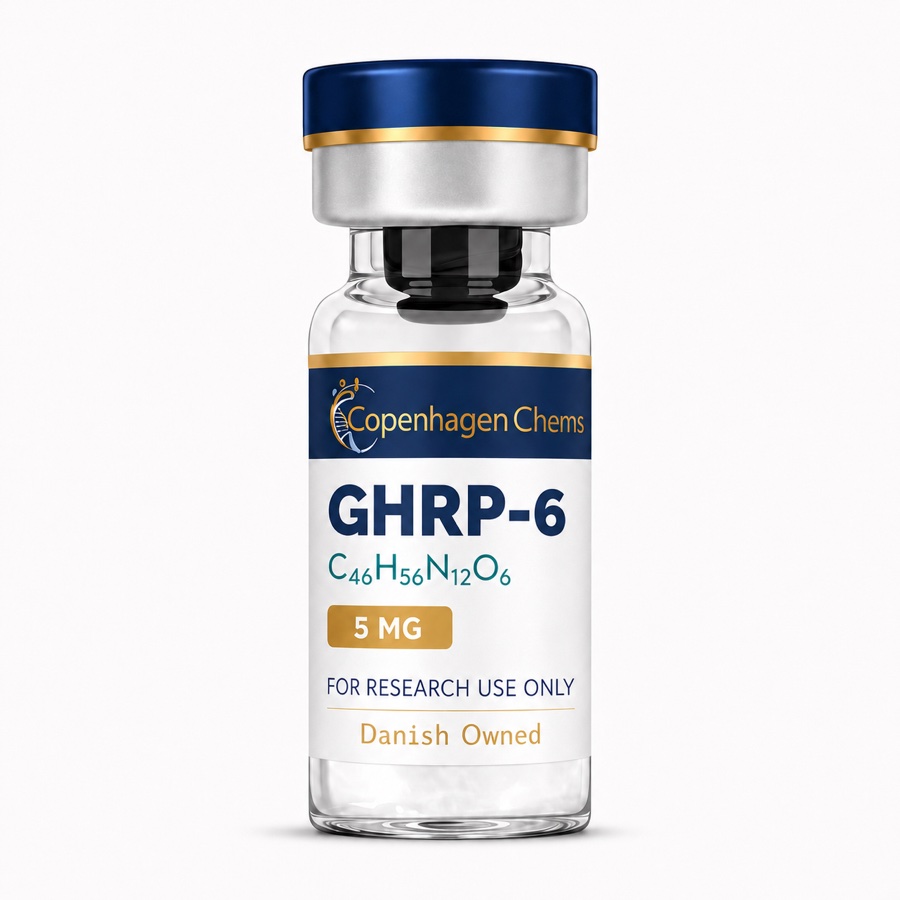
GHRP-6
Growth hormone-releasing peptide-6 (His-D-Trp-Ala-Trp-D-Phe-Lys-NH₂)
- CAS Number
- 87616-84-0
- Molecular Weight
- 873.0 g/mol
- Molecular Formula
- C₄₆H₅₆N₁₂O₆
Sequence
His-D-Trp-Ala-Trp-D-Phe-Lys-NH₂
Overview
GHRP-6 is a synthetic hexapeptide and one of the original growth hormone secretagogues — it predates the discovery of ghrelin itself, and was in fact one of the tools used to find the receptor that ghrelin turned out to occupy. It contains two D-amino acids, which slow enzymatic degradation. Unlike growth hormone-releasing hormone analogues such as sermorelin or CJC-1295, which act at the GHRH receptor, GHRP-6 acts at GHS-R1a, so the two classes are studied together in the literature for their combined effect. Because GHS-R1a is the ghrelin receptor, published work on GHRP-6 covers appetite and food intake as well as growth hormone release. A separate and substantial branch of the literature, much of it from Cuban groups, concerns cytoprotection in cardiac and other tissues through a CD36-dependent pathway that appears to be independent of growth hormone release. Human pharmacokinetic data exists in the indexed literature.
For research use only · Not FDA/EMA approved · Not for human consumption
Mechanism of Action
Published research describes GHRP-6 binding the growth hormone secretagogue receptor GHS-R1a on pituitary somatotrophs and in the hypothalamus, triggering a phospholipase C/IP₃ cascade, intracellular calcium release, and pulsatile growth hormone secretion. The literature reports that the effect is synergistic with GHRH rather than additive, because the two act through different receptors on the same cells, and that GHRP-6 also suppresses somatostatin tone. Through the same receptor in the hypothalamus, published studies describe stimulation of food intake — Yahashi and colleagues reported that GHRP-6 mimics ghrelin's effects on feeding and locomotor activity. A separate mechanism reported in the cytoprotection literature involves CD36 rather than GHS-R1a: Proulx and colleagues characterised azapeptide analogues of GHRP-6 as CD36 ligands, and Berlanga-Acosta and colleagues have reported cardioprotective effects in doxorubicin-induced injury. Delgado-Rubín de Célix and colleagues reported survival-factor activity in glutamate-induced excitotoxicity, and Granado and colleagues compared its effects with insulin on cell survival pathways.
For research use only · Not FDA/EMA approved · Not for human consumption
Key Research Areas
- Growth hormone release via GHS-R1a and synergy with GHRH
- Human pharmacokinetics in healthy volunteers
- Appetite and food intake through hypothalamic ghrelin signalling
- Cardioprotection in doxorubicin-induced and post-infarct models
- CD36-dependent cytoprotection distinct from GH release
- Neuronal survival in excitotoxicity models
- Growth hormone response in obese subjects
- Safety reviews of growth hormone secretagogues as a class
For research use only · Not FDA/EMA approved · Not for human consumption
Published Studies (8 cited)
| Author | Year | Key Finding | Source |
|---|---|---|---|
| Delgado-Rubín de Célix A et al. | 2006 | GHRP-6 acted as a survival factor in glutamate-induced excitotoxicity in cultured neurons. | View paper ↗ |
| Laferrère B et al. | 2006 | Obese subjects responded to the stimulatory effect of the ghrelin agonist GHRP-6 on growth hormone release. | View paper ↗ |
| Granado M et al. | 2011 | Insulin and GHRP-6 had differential beneficial effects on cell survival pathways in an experimental model. | View paper ↗ |
| Proulx C et al. | 2012 | Azapeptide analogues of GHRP-6 were characterised as CD36 receptor ligands, supporting a CD36-mediated pathway distinct from GHS-R1a. | View paper ↗ |
| Yahashi S et al. | 2012 | GHRP-6 mimicked ghrelin-induced stimulation of food intake and suppression of locomotor activity in goldfish. | View paper ↗ |
| Cabrales A et al. | 2013 | Pharmacokinetic study of GHRP-6 in nine healthy male volunteers, providing human exposure data for the peptide. | View paper ↗ |
| Sigalos JT et al. | 2018 | Review of the safety and efficacy evidence for growth hormone secretagogues as a class, including GHRP-6. | View paper ↗ |
| Berlanga-Acosta J et al. | 2024 | GHRP-6 prevented doxorubicin-induced myocardial and extra-myocardial damage in an experimental model. | View paper ↗ |
For research use only · Not FDA/EMA approved · Not for human consumption
Dosage in Published Research
The published human pharmacokinetic study administered single intravenous doses in the microgram-per-kilogram range to healthy volunteers. Rodent protocols in the cytoprotection literature commonly use 100–400 μg/kg by intraperitoneal or subcutaneous route, given acutely or over multi-day courses. Because the growth hormone response and the CD36-mediated cytoprotective response are reported at different exposures, protocols differ substantially depending on which endpoint is under study. No standardised research protocol exists. All figures are cited from published literature for reference only.
⚠️ Disclaimer: All dosage information is derived exclusively from published scientific literature and is presented for informational reference only. This does not constitute dosing guidance for any application.
For research use only · Not FDA/EMA approved · Not for human consumption
Storage & Handling
Store lyophilized powder at -20°C for long-term storage. Once reconstituted, store at 2–8°C and use within 14 days. Protect from light, moisture, and repeated freeze-thaw cycles. Handle under sterile laboratory conditions using appropriate PPE.
For research use only · Not FDA/EMA approved · Not for human consumption
Safety Profile (Literature Only)
The published human pharmacokinetic study reported the peptide as tolerated at the single doses investigated in healthy volunteers, and the class review by Sigalos and colleagues surveys the broader safety literature on growth hormone secretagogues. Published work notes that GHS-R1a agonism raises cortisol and prolactin to a greater degree than more selective secretagogues such as ipamorelin, which is a recurring point of comparison in the literature. No LD50 has been established in the indexed literature. This compound is for laboratory research use only.
For research use only · Not FDA/EMA approved · Not for human consumption
Related Compounds
Ipamorelin
A selective growth hormone secretagogue with high GH specificity, investigated for its clean release profile without cortisol or prolactin elevation.
HormonesCJC-1295
A synthetic GHRH analog with extended half-life, researched for sustained growth hormone axis stimulation in clinical settings.
HormonesHexarelin
A potent hexapeptide growth hormone secretagogue with unique cardioprotective properties independent of GH release, studied in Phase 2 cardiac trials.
For research use only · Not FDA/EMA approved · Not for human consumption