
For research use only · Not FDA/EMA approved · Not for human consumption
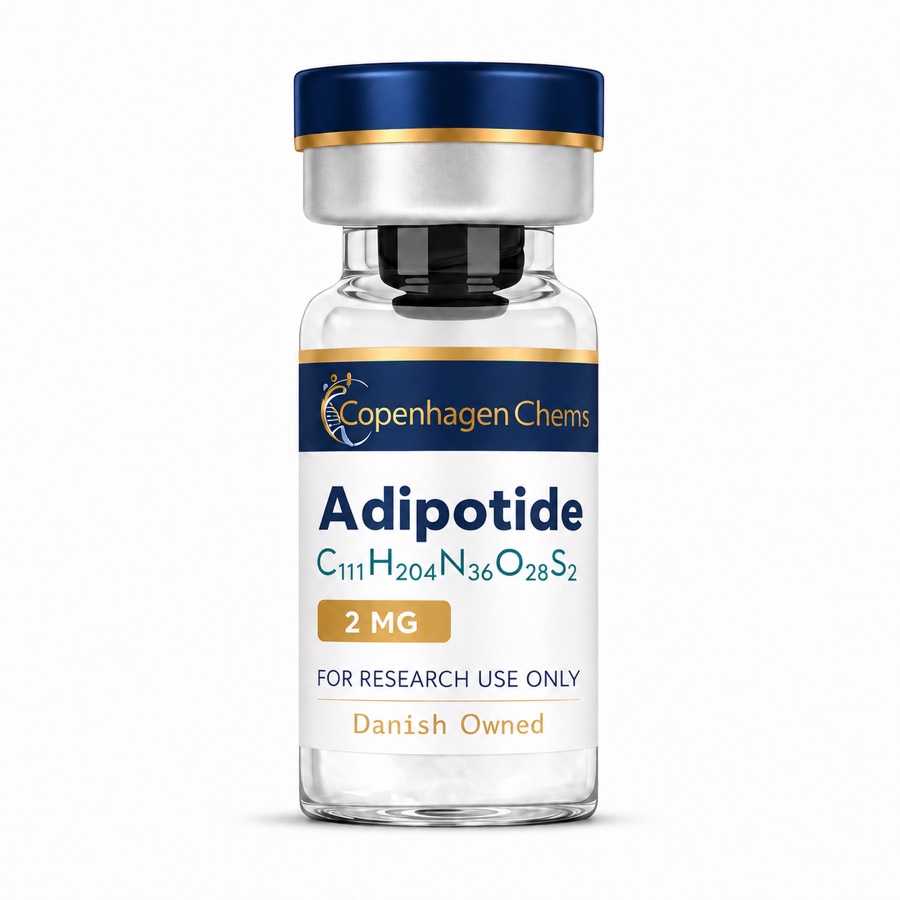
Adipotide
Prohibitin-targeting peptidomimetic (FTPP, CKGGRAKDC-GG-D(KLAKLAK)₂)
- CAS Number
- 859216-15-2
- Molecular Weight
- 2557.2 g/mol
- Molecular Formula
- C₁₁₁H₂₀₆N₃₆O₂₈S₂
Sequence
CKGGRAKDC-GG-D(KLAKLAK)₂
Overview
Adipotide is a synthetic peptidomimetic built from two functional halves joined by a glycine-glycine linker. The first half, the nine-residue homing sequence CKGGRAKDC, was identified by phage display as binding prohibitin, a protein reported to be enriched on the endothelium of blood vessels supplying white adipose tissue. The second half is D(KLAKLAK)₂, a D-amino acid sequence that disrupts mitochondrial membranes once inside a cell. The design intent described in the published literature is targeted ablation of the blood supply to white fat rather than a metabolic or appetite effect. The compound entered the literature with Kolonin and colleagues in Nature Medicine in 2004 and reached a non-human primate study reported in Science Translational Medicine in 2011. The published record is small — a handful of primary studies and a published critique — and the compound has not progressed to a completed human efficacy trial in the indexed literature. Renal effects reported in the primate work are discussed in the studies below and in the published comment on them.
For research use only · Not FDA/EMA approved · Not for human consumption
Mechanism of Action
Published research describes a two-stage mechanism. The homing sequence is reported to bind prohibitin on the surface of endothelial cells lining white adipose tissue vasculature, concentrating the construct at that tissue rather than distributing it evenly. The D(KLAKLAK)₂ portion is described in the literature as a mitochondrial membrane–disrupting sequence that is inactive extracellularly but triggers apoptosis once internalised. The reported consequence in animal models is apoptosis of the targeted endothelium, reduced perfusion of white fat depots, and subsequent loss of adipose mass. Because the mechanism acts on vasculature rather than on adipocyte metabolism, the published literature frames the resulting weight change as a consequence of tissue ablation. Investigators have also reported effects on insulin resistance in obese primates that were described as independent of the degree of weight loss, and the accompanying published comment raised questions about renal proximal tubule exposure, since prohibitin is not exclusive to adipose endothelium.
For research use only · Not FDA/EMA approved · Not for human consumption
Key Research Areas
- Targeted ablation of white adipose tissue vasculature in rodent models
- Body weight and adiposity changes in diet-induced and genetically obese mice
- Insulin resistance and glycaemic measures in obese rhesus monkeys
- Prohibitin as a vascular address in adipose tissue
- Renal exposure and proximal tubule effects raised in published commentary
- Comparison with nanoparticle-based adipose-targeting delivery systems
For research use only · Not FDA/EMA approved · Not for human consumption
Published Studies (4 cited)
| Author | Year | Key Finding | Source |
|---|---|---|---|
| Kolonin MG et al. | 2004 | Original report describing reversal of obesity in mice by targeted ablation of adipose tissue vasculature using a prohibitin-homing pro-apoptotic peptide. | View paper ↗ |
| Barnhart KF et al. | 2011 | In obese rhesus monkeys the peptidomimetic was associated with weight loss and improved insulin resistance; the authors also reported renal findings on histology. | View paper ↗ |
| Criscione L | 2012 | Published comment on the primate study questioning interpretation of the results, including the extent of renal exposure and the specificity of the adipose-vascular target. | View paper ↗ |
| Hossen N et al. | 2013 | Compared nanoparticle-targeted delivery with peptide bioconjugates directed at adipose vasculature as approaches to obesity in animal models. | View paper ↗ |
For research use only · Not FDA/EMA approved · Not for human consumption
Dosage in Published Research
Published animal protocols have used daily subcutaneous administration over short courses — typically in the range of 0.4–3.4 mg/kg/day in mice and approximately 0.43 mg/kg/day in the reported rhesus study, given in cycles rather than continuously. Dosing differs substantially between the rodent and primate literature and no standardised research protocol exists. The primate study reported dose-dependent renal findings, which is the reason published protocols use limited treatment cycles. All figures are cited from published literature for reference only.
⚠️ Disclaimer: All dosage information is derived exclusively from published scientific literature and is presented for informational reference only. This does not constitute dosing guidance for any application.
For research use only · Not FDA/EMA approved · Not for human consumption
Storage & Handling
Store lyophilized powder at -20°C for long-term storage. Once reconstituted, store at 2–8°C and use within 14 days. Protect from light, moisture, and repeated freeze-thaw cycles. Handle under sterile laboratory conditions using appropriate PPE.
For research use only · Not FDA/EMA approved · Not for human consumption
Safety Profile (Literature Only)
The published primate study reported dose-dependent renal changes on histology, and the subsequent published comment in the same journal focused on that finding. No human clinical safety data is available in the indexed literature, and no LD50 has been established. The evidence base for this compound is small — four primary sources including one critical commentary — which is materially thinner than for the better-studied compounds in this database. This compound is for laboratory research use only.
For research use only · Not FDA/EMA approved · Not for human consumption
Related Compounds
Retatrutide
A novel triple GIP/GLP-1/glucagon receptor agonist investigated in clinical trials for metabolic research.
LongevityMOTS-c
A mitochondria-derived peptide (MDP) discovered in 2015, investigated for AMPK activation and metabolic regulation in aging research.
Weight LossAOD-9604
A 16-amino-acid fragment corresponding to the C-terminal lipolytic domain of human growth hormone, studied for effects on fat metabolism without the growth-promoting activity of the full hormone.
For research use only · Not FDA/EMA approved · Not for human consumption