
For research use only · Not FDA/EMA approved · Not for human consumption
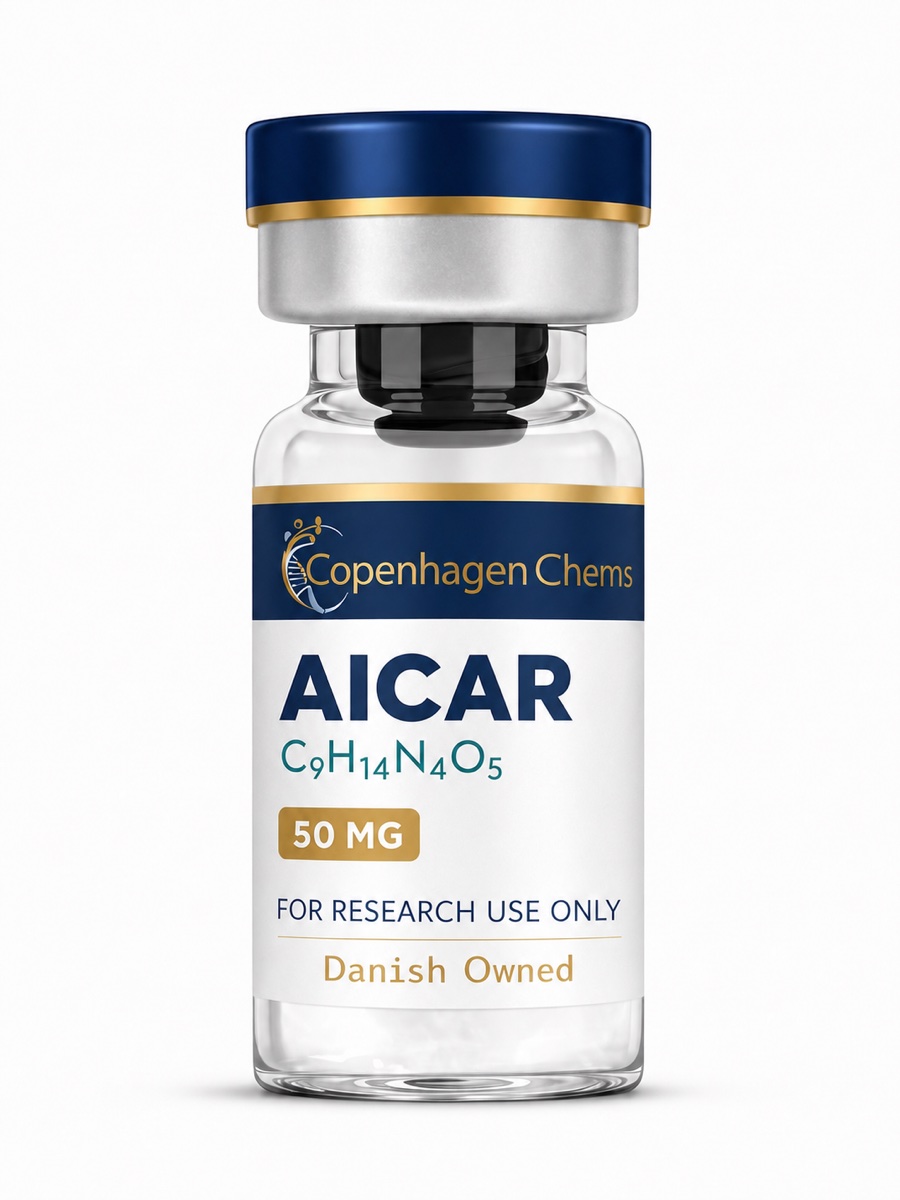
AICAR
Acadesine (5-aminoimidazole-4-carboxamide riboside, AICA riboside)
- CAS Number
- 2627-69-2
- Molecular Weight
- 258.23 g/mol
- Molecular Formula
- C₉H₁₄N₄O₅
Overview
AICAR — acadesine, or AICA riboside — is not a peptide but a purine nucleoside analogue, and it is included in this database because it appears in the same metabolic research literature as several of the peptides above. Once taken up by the cell it is phosphorylated to ZMP, a molecule that mimics AMP closely enough to activate AMP-activated protein kinase (AMPK) allosterically. AMPK is the central cellular energy sensor, and because AICAR activates it without the cell actually being energy-depleted, it has become a standard experimental tool for asking what AMPK activation does in isolation. The published literature is substantial and spans skeletal muscle glucose uptake, insulin sensitivity, mitochondrial biogenesis, cardioprotection, and cognition in rodent models. It is also a prohibited substance in sport, and part of the indexed literature concerns its detection in doping control. Unlike most compounds in this database, the evidence base here is broad and comes from many independent laboratories.
For research use only · Not FDA/EMA approved · Not for human consumption
Mechanism of Action
Published research describes AICAR entering cells through adenosine transporters and being phosphorylated by adenosine kinase to ZMP (AICAR monophosphate). ZMP binds the γ-subunit of AMPK at the sites normally occupied by AMP, producing allosteric activation and promoting phosphorylation of Thr172 on the α-subunit by upstream kinases including LKB1. Nakano and colleagues reported that this activation is isoform-selective, favouring the α2 complex. Downstream, published studies describe increased GLUT4 translocation and glucose uptake in skeletal muscle independent of insulin, increased fatty acid oxidation through inhibition of acetyl-CoA carboxylase, and transcriptional effects on mitochondrial biogenesis. Cantó and colleagues reported that AMPK activation modulates NAD+ metabolism and SIRT1 activity, linking the pathway to the sirtuin literature. Kjøbsted and colleagues have reported that prior AICAR stimulation increases subsequent insulin sensitivity in an AMPK-dependent manner requiring TBC1D4. Dolinar and colleagues reported an important experimental caveat: nucleosides present in culture media can block AICAR-stimulated AMPK activation, which matters for interpreting in vitro work.
For research use only · Not FDA/EMA approved · Not for human consumption
Key Research Areas
- AMPK activation and isoform selectivity in skeletal muscle
- Insulin-independent glucose uptake and GLUT4 expression
- Prior-stimulation effects on subsequent insulin sensitivity (TBC1D4-dependent)
- Fatty acid oxidation and mitochondrial biogenesis
- NAD+ metabolism and SIRT1 crosstalk
- Cardioprotection in ischaemia models
- Cognition and motor coordination in young and aged mice
- Detection and metabolism in doping control samples
For research use only · Not FDA/EMA approved · Not for human consumption
Published Studies (8 cited)
| Author | Year | Key Finding | Source |
|---|---|---|---|
| Holmes BF et al. | 1999 | Chronic AMPK activation with AICAR increased GLUT-4, hexokinase and glycogen content in rat skeletal muscle. | View paper ↗ |
| Iglesias MA et al. | 2004 | AMPK activation by AICAR increased both fatty acid and glucose uptake in muscle of insulin-resistant rats. | View paper ↗ |
| Nakano M et al. | 2006 | Reported α2 isoform-specific activation of AMPK by AICAR, indicating the response is not uniform across AMPK complexes. | View paper ↗ |
| Moopanar TR et al. | 2006 | AICAR inhibited the Na+/H+ exchanger in rat hearts, proposed as a possible contribution to cardioprotection. | View paper ↗ |
| Cantó C et al. | 2009 | AMPK regulates energy expenditure by modulating NAD+ metabolism and SIRT1 activity, linking AMPK activation to sirtuin signalling. | View paper ↗ |
| Kobilo T et al. | 2014 | The AMPK agonist AICAR improved cognition and motor coordination in young and aged mice. | View paper ↗ |
| Kjøbsted R et al. | 2019 | TBC1D4 is necessary for the enhanced muscle insulin sensitivity produced by AICAR and by contraction. | View paper ↗ |
| Dolinar K et al. | 2018 | Nucleosides in the culture medium block AICAR-stimulated AMPK activation — a methodological caveat for in vitro studies. | View paper ↗ |
For research use only · Not FDA/EMA approved · Not for human consumption
Dosage in Published Research
Published rodent protocols commonly use 250–500 mg/kg/day by intraperitoneal or subcutaneous injection, with chronic studies running from days to several weeks. In vitro work typically uses 0.5–2 mM in culture medium, and the Dolinar work above is a reminder that medium composition materially affects the response at those concentrations. Protocols vary widely by tissue and model, and no standardised research protocol exists. All figures are cited from published literature for reference only.
⚠️ Disclaimer: All dosage information is derived exclusively from published scientific literature and is presented for informational reference only. This does not constitute dosing guidance for any application.
For research use only · Not FDA/EMA approved · Not for human consumption
Storage & Handling
Store lyophilized powder at -20°C for long-term storage, protected from light and moisture. Solutions in aqueous buffer should be prepared fresh where possible; if stored, keep at 2–8°C and use within 14 days. Avoid repeated freeze-thaw cycles. Handle under sterile laboratory conditions using appropriate PPE.
For research use only · Not FDA/EMA approved · Not for human consumption
Safety Profile (Literature Only)
Acadesine has been studied in human clinical trials in cardiac surgery and in haematological indications under its pharmaceutical name, so more human exposure data exists for this compound than for most in this database — but that data belongs to specific clinical contexts and does not transfer to research use. Published rodent studies describe tolerance of chronic dosing at the levels above. AICAR is on the WADA prohibited list, and part of the published literature concerns its detection in competition samples. This compound is for laboratory research use only.
For research use only · Not FDA/EMA approved · Not for human consumption
Related Compounds
NAD+
An essential coenzyme present in all living cells, investigated for its declining levels with age and role in sirtuin-mediated longevity pathways.
LongevityMOTS-c
A mitochondria-derived peptide (MDP) discovered in 2015, investigated for AMPK activation and metabolic regulation in aging research.
Weight LossAdipotide
A two-part peptidomimetic that homes to the vasculature of white adipose tissue and carries a pro-apoptotic sequence, studied in rodent and non-human primate obesity models.
For research use only · Not FDA/EMA approved · Not for human consumption