
For research use only · Not FDA/EMA approved · Not for human consumption
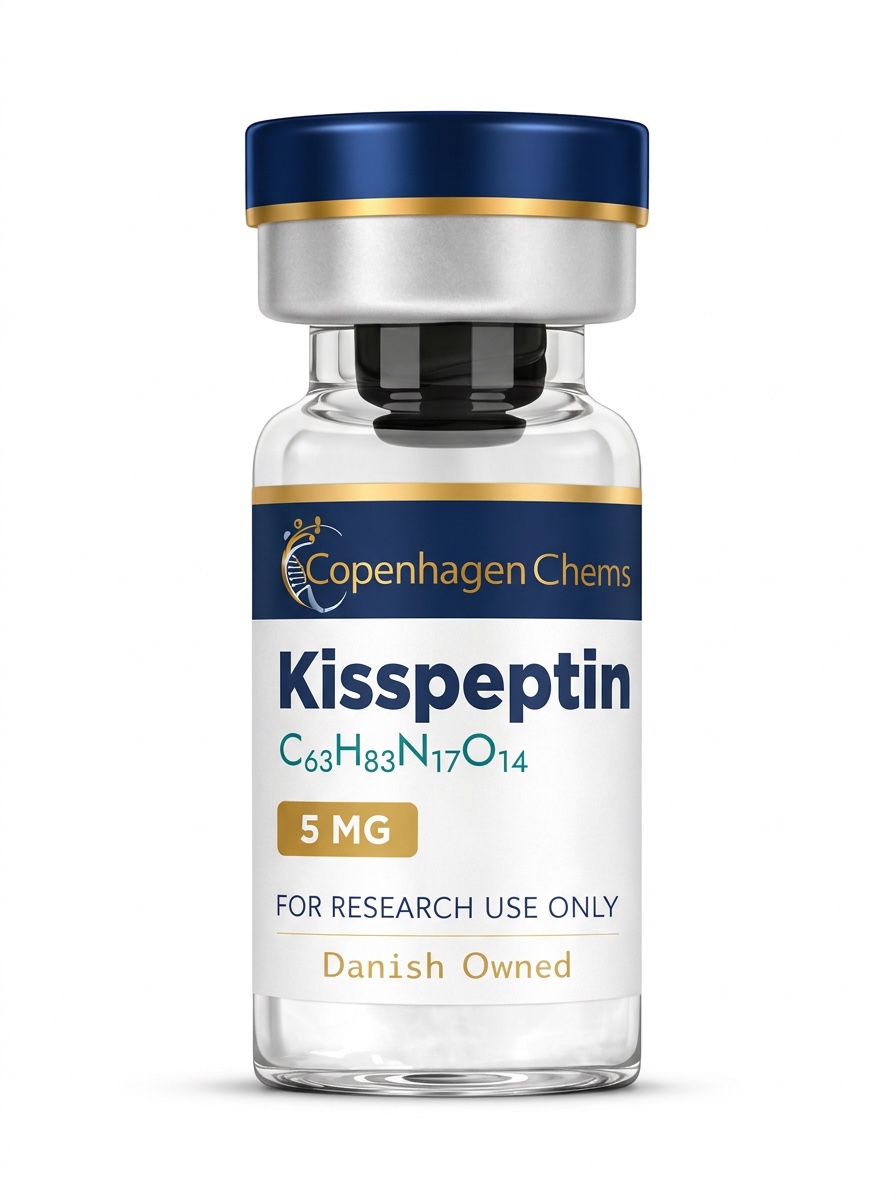
Kisspeptin-10
Kisspeptin-10 (Metastin 45-54, KP-10)
- CAS Number
- 374675-21-5
- Molecular Weight
- 1302.45 g/mol
- Molecular Formula
- C₆₃H₈₃N₁₇O₁₄
Sequence
Tyr-Asn-Trp-Asn-Ser-Phe-Gly-Leu-Arg-Phe-NH₂
Available in Shop
Overview
Kisspeptin-10 is the biologically active decapeptide fragment of kisspeptin, the peptide product of the KISS1 gene. The gene was originally identified in cancer research as a metastasis suppressor — hence the alternative name metastin — before its role in reproductive endocrinology was recognised. That recognition came from human genetics: loss-of-function mutations in the kisspeptin receptor were found to cause failure of puberty, establishing kisspeptin signalling as a required upstream input to the reproductive axis. Published human work has since used kisspeptin administration as an investigational probe of that axis, including studies examining whether kisspeptin responsiveness can predict pubertal outcomes.
For research use only · Not FDA/EMA approved · Not for human consumption
Mechanism of Action
Published research describes kisspeptin-10 as an agonist at KISS1R (also designated GPR54), a G-protein coupled receptor expressed on gonadotropin-releasing hormone (GnRH) neurons in the hypothalamus. Receptor activation is described as stimulating GnRH release, which in turn drives pituitary secretion of luteinising hormone and follicle-stimulating hormone. The literature positions kisspeptin as sitting upstream of GnRH in this cascade, which is the basis for its experimental use: it permits investigation of the axis at a level above GnRH itself. Published work has examined intravenous, subcutaneous and, more recently, intranasal administration routes.
For research use only · Not FDA/EMA approved · Not for human consumption
Key Research Areas
- Gonadotropin release following kisspeptin administration in humans
- Kisspeptin responsiveness as a predictor of pubertal outcome
- Investigational use in female reproductive disorders
- Comparison of administration routes including intranasal delivery
- KISS1R signalling on GnRH neurons
For research use only · Not FDA/EMA approved · Not for human consumption
Published Studies (4 cited)
| Author | Year | Key Finding | Source |
|---|---|---|---|
| Mills EG et al. | 2025 | Intranasal kisspeptin administration rapidly stimulated gonadotropin release in humans. | View paper ↗ |
| Abbara A et al. | 2020 | Investigated the therapeutic potential of a kisspeptin receptor agonist in female reproductive disorders. | View paper ↗ |
| Lippincott MF et al. | 2016 | Kisspeptin responsiveness signalled the emergence of reproductive endocrine activity, with implications for understanding human puberty. | View paper ↗ |
| Chan YM et al. | 2020 | Examined the use of kisspeptin to predict pubertal outcomes in youth with delayed puberty. | View paper ↗ |
For research use only · Not FDA/EMA approved · Not for human consumption
Dosage in Published Research
Published human studies have most often administered kisspeptin-10 by intravenous bolus or infusion, with bolus doses in published protocols commonly expressed per kilogram of body weight in the nanomole range, and infusion protocols expressed as nmol/kg/h. A 2025 study reported intranasal administration as an alternative route. Protocols vary substantially between studies and populations. All figures are reported from published literature for reference purposes only.
⚠️ Disclaimer: All dosage information is derived exclusively from published scientific literature and is presented for informational reference only. This does not constitute dosing guidance for any application.
For research use only · Not FDA/EMA approved · Not for human consumption
Storage & Handling
Store lyophilized powder at -20°C for long-term storage, protected from light and moisture. Once reconstituted, store at 2–8°C and use within 14 days. Kisspeptin-10 is susceptible to enzymatic degradation and has a short circulating half-life as described in the published pharmacokinetic literature. Avoid repeated freeze-thaw cycles. Handle under sterile laboratory conditions using appropriate PPE.
For research use only · Not FDA/EMA approved · Not for human consumption
Safety Profile (Literature Only)
Published human investigational studies have generally described kisspeptin-10 administration as well tolerated in the study populations and at the doses examined, with the literature reporting no consistent pattern of serious adverse effects in those settings. The published record concerns controlled investigational administration in clinical research environments. No safety profile has been established outside those conditions. This compound is supplied for laboratory research use only.
For research use only · Not FDA/EMA approved · Not for human consumption
Related Compounds
Ipamorelin
A selective growth hormone secretagogue with high GH specificity, investigated for its clean release profile without cortisol or prolactin elevation.
HormonesOxytocin
A nine-amino-acid neuropeptide hormone, studied extensively in intranasal administration protocols for effects on social cognition.
HormonesPT-141
A cyclic melanocortin receptor agonist derived from α-MSH, investigated in controlled clinical trials for sexual arousal endpoints.
For research use only · Not FDA/EMA approved · Not for human consumption