
For research use only · Not FDA/EMA approved · Not for human consumption
L-Carnitine
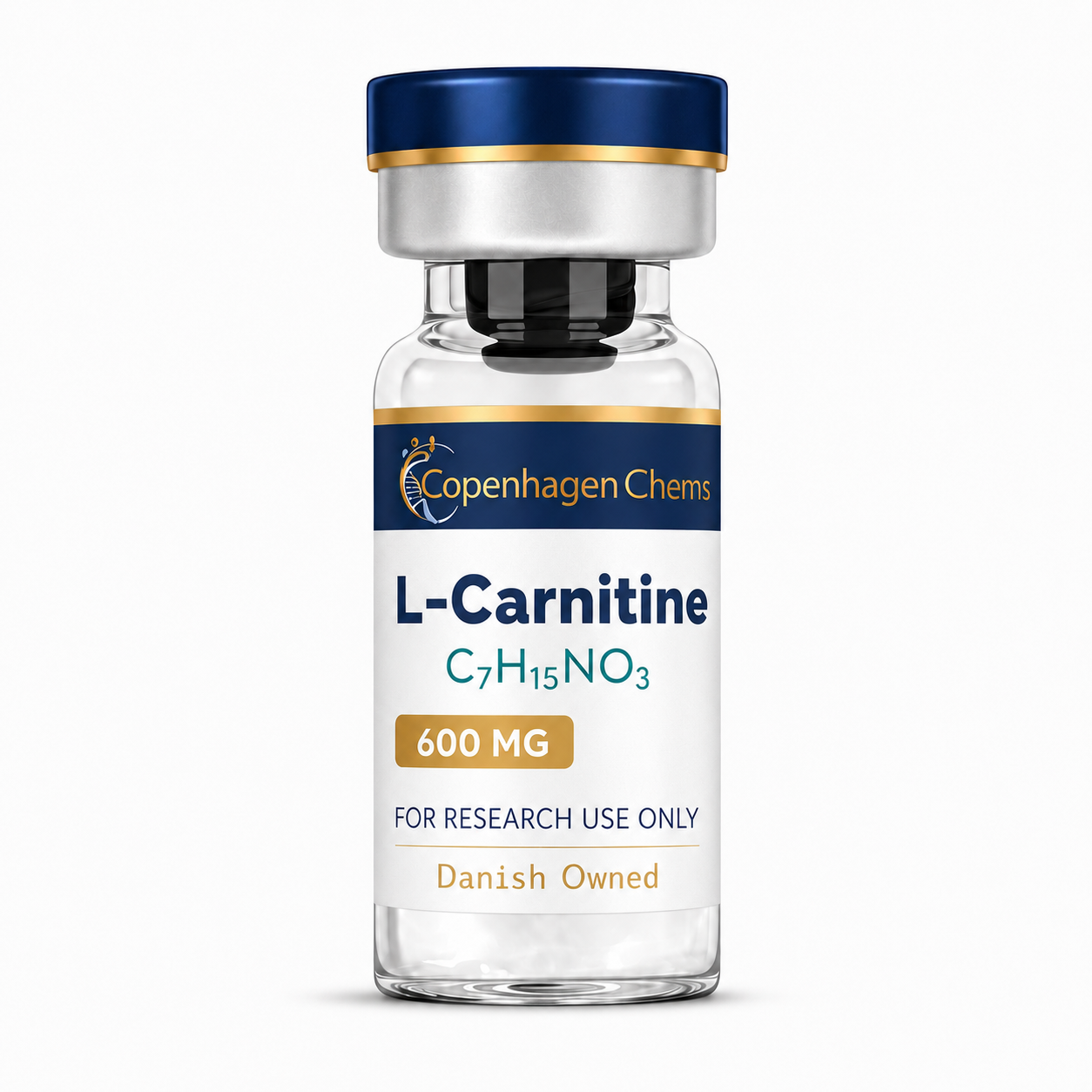
L-Carnitine (Levocarnitine)
- CAS Number
- 541-15-1
- Molecular Weight
- 161.20 g/mol
- Molecular Formula
- C₇H₁₅NO₃
Overview
L-Carnitine is a small quaternary ammonium compound, not a peptide, synthesised endogenously from lysine and methionine and also obtained from dietary sources, principally red meat. Its established biochemical role is in the carnitine shuttle, the mechanism by which long-chain fatty acids are transported across the inner mitochondrial membrane for beta-oxidation. Because this role is well characterised and non-controversial, L-carnitine occupies an unusual position among research compounds: the biochemistry is settled, while the question of whether supplementation produces measurable functional effects in people who are not deficient remains actively contested in the published trial literature, with both positive and null randomised results.
For research use only · Not FDA/EMA approved · Not for human consumption
Mechanism of Action
Published biochemistry describes L-carnitine as an obligatory cofactor in the carnitine shuttle. Carnitine palmitoyltransferase I esterifies long-chain fatty acyl-CoA to acylcarnitine on the outer mitochondrial membrane; carnitine-acylcarnitine translocase transports the acylcarnitine across the inner membrane; carnitine palmitoyltransferase II regenerates acyl-CoA within the matrix for beta-oxidation. Published work also describes a buffering role for the free carnitine pool in modulating the mitochondrial acetyl-CoA to CoA ratio. In the exercise literature, proposed mechanisms for supplementation effects include altered substrate utilisation and effects on markers of muscle damage, though the published trials do not agree on whether these translate to performance outcomes.
For research use only · Not FDA/EMA approved · Not for human consumption
Key Research Areas
- Exercise recovery and markers of muscle damage in randomised trials
- Aerobic and anaerobic performance outcomes, including null findings
- Fatigue and exercise capacity in haemodialysis patients
- The carnitine shuttle and mitochondrial fatty acid oxidation
- Clinical carnitine deficiency states
For research use only · Not FDA/EMA approved · Not for human consumption
Published Studies (4 cited)
| Author | Year | Key Finding | Source |
|---|---|---|---|
| Stefan M et al. | 2021 | L-carnitine tartrate supplementation for five weeks improved measures of exercise recovery in men and women in a randomised, double-blind, placebo-controlled trial. | View paper ↗ |
| de Rozas A et al. | 2025 | L-carnitine and alpha-lipoic acid failed to improve anaerobic and aerobic performance in trained cyclists despite a reduction in blood lactate concentration — a null performance result. | View paper ↗ |
| Brass EP et al. | 2001 | Intravenous L-carnitine increased plasma carnitine, reduced fatigue and may have helped preserve exercise capacity in haemodialysis patients. | View paper ↗ |
| Smith WA et al. | 2008 | Examined the effect of glycine propionyl-L-carnitine on aerobic and anaerobic exercise performance. | View paper ↗ |
For research use only · Not FDA/EMA approved · Not for human consumption
Dosage in Published Research
Published human trials have most commonly used oral doses in the range of approximately 1 g to 4 g per day, frequently as L-carnitine L-tartrate in the exercise literature, over supplementation periods of several weeks. Intravenous protocols in the haemodialysis literature use different dosing tied to dialysis sessions. Protocols vary substantially by population and formulation. All figures are reported from published clinical literature for reference purposes only.
⚠️ Disclaimer: All dosage information is derived exclusively from published scientific literature and is presented for informational reference only. This does not constitute dosing guidance for any application.
For research use only · Not FDA/EMA approved · Not for human consumption
Storage & Handling
Store the solid at room temperature or refrigerated, protected from moisture. L-carnitine is markedly hygroscopic and will absorb atmospheric water, so containers should be kept tightly sealed and equilibrated to room temperature before opening to avoid condensation. Aqueous solutions should be refrigerated and used promptly. Handle under laboratory conditions using appropriate PPE.
For research use only · Not FDA/EMA approved · Not for human consumption
Safety Profile (Literature Only)
Published trial literature describes oral L-carnitine as generally well tolerated at the doses studied, with gastrointestinal effects and a characteristic body odour at higher intakes among the reported effects. A separate published research question concerns the conversion of carnitine by gut microbiota to trimethylamine-N-oxide (TMAO) and the proposed relevance of TMAO to cardiovascular risk; this remains an active area of published debate rather than a settled finding. This compound is supplied for laboratory research use only.
For research use only · Not FDA/EMA approved · Not for human consumption
Related Compounds
NAD+
An essential coenzyme present in all living cells, investigated for its declining levels with age and role in sirtuin-mediated longevity pathways.
LongevityMOTS-c
A mitochondria-derived peptide (MDP) discovered in 2015, investigated for AMPK activation and metabolic regulation in aging research.
Weight LossAICAR
A nucleoside analogue that is phosphorylated inside the cell to a compound mimicking AMP, making it one of the most widely used experimental activators of AMP-activated protein kinase.
For research use only · Not FDA/EMA approved · Not for human consumption