
For research use only · Not FDA/EMA approved · Not for human consumption
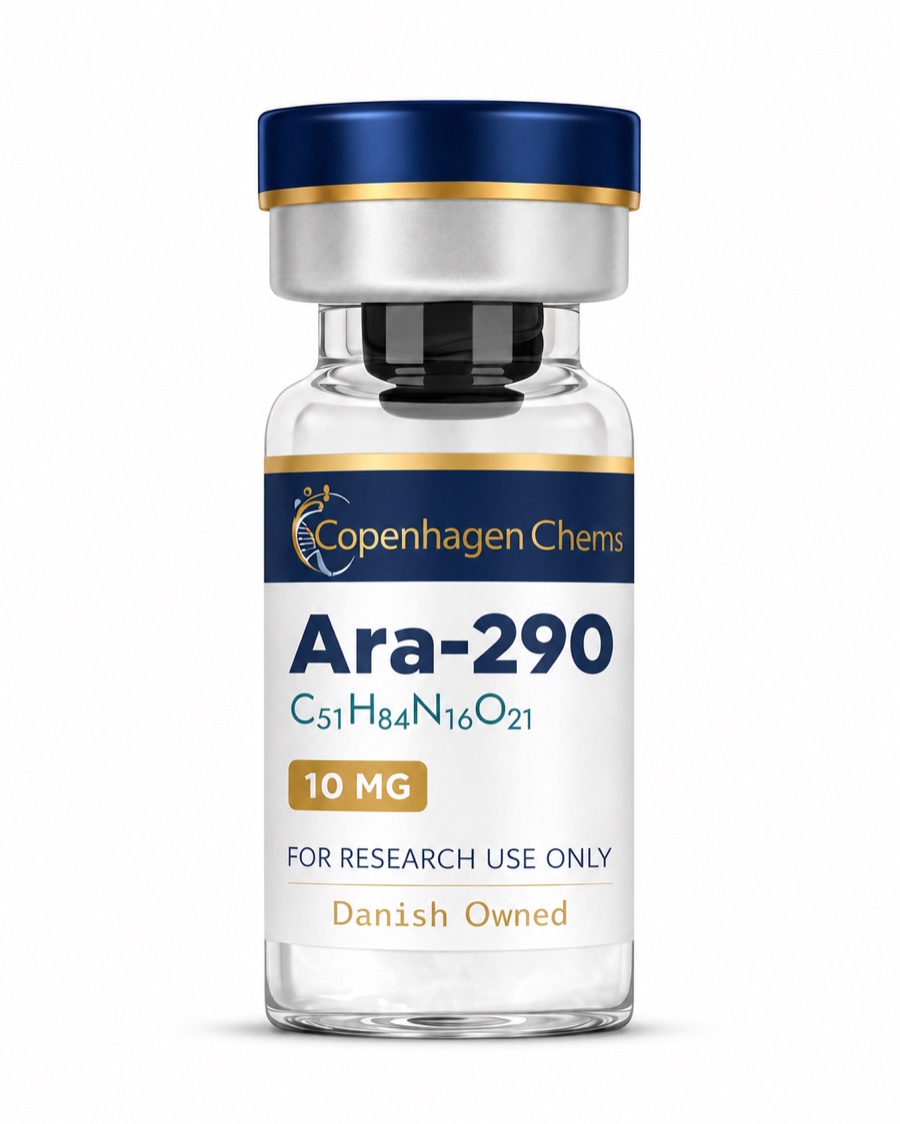
Ara-290
Cibinetide (pyroglutamate helix B surface peptide, pHBSP)
- CAS Number
- 1208243-50-8
- Molecular Weight
- 1257.3 g/mol
- Molecular Formula
- C₅₁H₈₄N₁₆O₂₁
Sequence
Pyr-Glu-Gln-Leu-Glu-Arg-Ala-Leu-Asn-Ser-Ser
Overview
Ara-290, also called cibinetide, is a short peptide taken from the outer surface of helix B of erythropoietin — the face of the molecule that does not contact the classical EPO receptor. The research premise is that erythropoietin's tissue-protective effects are mediated by a different receptor complex from its haematopoietic effects: a heteromer of the EPO receptor and the β-common receptor (CD131), described in the literature as the innate repair receptor. A peptide reproducing only the relevant surface should therefore engage tissue protection without raising haematocrit. Among the compounds added to this database, Ara-290 has the strongest human evidence base: it has been through randomised, placebo-controlled trials in sarcoidosis-associated small fibre neuropathy, with published results in Molecular Medicine and Investigative Ophthalmology & Visual Science. The preclinical literature is broad, covering wound healing, colitis, islet transplantation, neuropathy, cardiac inflammation and bone.
For research use only · Not FDA/EMA approved · Not for human consumption
Mechanism of Action
Published research describes Ara-290 binding the innate repair receptor, a heteromeric complex of the EPO receptor and the β-common receptor (CD131), while having negligible affinity for the EPO receptor homodimer that drives erythropoiesis. Engagement of this complex has been reported to activate JAK2/STAT signalling and downstream anti-apoptotic and anti-inflammatory pathways in injured tissue, without the increase in red cell mass that limits erythropoietin itself. Nairz and colleagues reported dampening of innate immune cell function in experimental colitis, and Bitto and colleagues reported that activation of the EPOR-β common receptor complex improved impaired wound healing. Work in the eye and in peripheral nerve has reported effects on small nerve fibre regeneration, and Brines and colleagues reported effects on metabolic control alongside neuropathic endpoints. Collino and colleagues framed the general mechanism as a switch for innate protection and repair with effects outlasting the peptide's short plasma half-life.
For research use only · Not FDA/EMA approved · Not for human consumption
Key Research Areas
- Innate repair receptor (EPOR/β-common) engagement without erythropoiesis
- Small fibre neuropathy in sarcoidosis — randomised controlled human trials
- Corneal nerve fibre abundance measured by confocal microscopy
- Wound healing in models of impaired repair
- Experimental colitis and innate immune cell function
- Islet allograft function in transplantation models
- Cardiac inflammation and ageing-related changes
- Metabolic control alongside neuropathic endpoints
For research use only · Not FDA/EMA approved · Not for human consumption
Published Studies (8 cited)
| Author | Year | Key Finding | Source |
|---|---|---|---|
| Heij L et al. | 2012 | Randomised trial of ARA 290 in sarcoidosis patients with symptoms of small fibre neuropathy, reporting on safety and efficacy endpoints. | View paper ↗ |
| Dahan A et al. | 2013 | ARA 290 improved symptoms in patients with sarcoidosis-associated small nerve fibre loss and increased corneal nerve fibre measures. | View paper ↗ |
| van Velzen M et al. | 2014 | Review of ARA 290 for treatment of small fibre neuropathy in sarcoidosis, summarising the trial evidence to that date. | View paper ↗ |
| Brines M et al. | 2015 | ARA 290, engineered from erythropoietin, improved metabolic control and neuropathic endpoints without stimulating erythropoiesis. | View paper ↗ |
| Collino M et al. | 2015 | Review describing the innate repair receptor as a molecular switch for tissue protection, with effects outlasting the peptide's plasma presence. | View paper ↗ |
| Culver DA et al. | 2017 | Cibinetide improved corneal nerve fibre abundance in patients with sarcoidosis-associated small nerve fibre loss. | View paper ↗ |
| Nairz M et al. | 2017 | Cibinetide dampened innate immune cell functions and ameliorated the course of experimental colitis in mice. | View paper ↗ |
| Bitto A et al. | 2018 | Activation of the EPOR-β common receptor complex by cibinetide improved impaired wound healing in an experimental model. | View paper ↗ |
For research use only · Not FDA/EMA approved · Not for human consumption
Dosage in Published Research
Published human trial protocols in sarcoidosis used 2–8 mg administered subcutaneously, given daily or on alternating schedules over courses of four weeks or longer. Rodent protocols vary more widely and are commonly reported in the range of 10–120 μg/kg. Because a substantial part of this compound's literature is clinical rather than preclinical, published figures are better characterised than for most compounds in this database — but they remain trial protocols reported for reference and not a research dosing standard. All figures are cited from published literature for reference only.
⚠️ Disclaimer: All dosage information is derived exclusively from published scientific literature and is presented for informational reference only. This does not constitute dosing guidance for any application.
For research use only · Not FDA/EMA approved · Not for human consumption
Storage & Handling
Store lyophilized powder at -20°C for long-term storage. Once reconstituted, store at 2–8°C and use within 14 days. Protect from light, moisture, and repeated freeze-thaw cycles. Handle under sterile laboratory conditions using appropriate PPE.
For research use only · Not FDA/EMA approved · Not for human consumption
Safety Profile (Literature Only)
Published randomised controlled trials in sarcoidosis reported the peptide as generally well tolerated over the courses studied, with the design intent — and the reported result — being no clinically meaningful change in haemoglobin or haematocrit, in contrast to erythropoietin. This is a comparatively well-characterised safety picture by the standards of this database, but it derives from specific patient populations and defined trial protocols and does not generalise. No LD50 has been established in the indexed literature. This compound is for laboratory research use only.
For research use only · Not FDA/EMA approved · Not for human consumption
Related Compounds
BPC-157
A pentadecapeptide derived from human gastric juice, extensively studied for tissue-protective properties in animal models.
Skin & TissueGHK-Cu
A naturally occurring copper-binding tripeptide studied for its role in tissue remodeling, wound repair, and gene expression modulation.
RecoveryTB-500
A synthetic fragment of thymosin beta-4 researched for actin-binding properties and tissue repair mechanisms in preclinical models.
For research use only · Not FDA/EMA approved · Not for human consumption