
For research use only · Not FDA/EMA approved · Not for human consumption
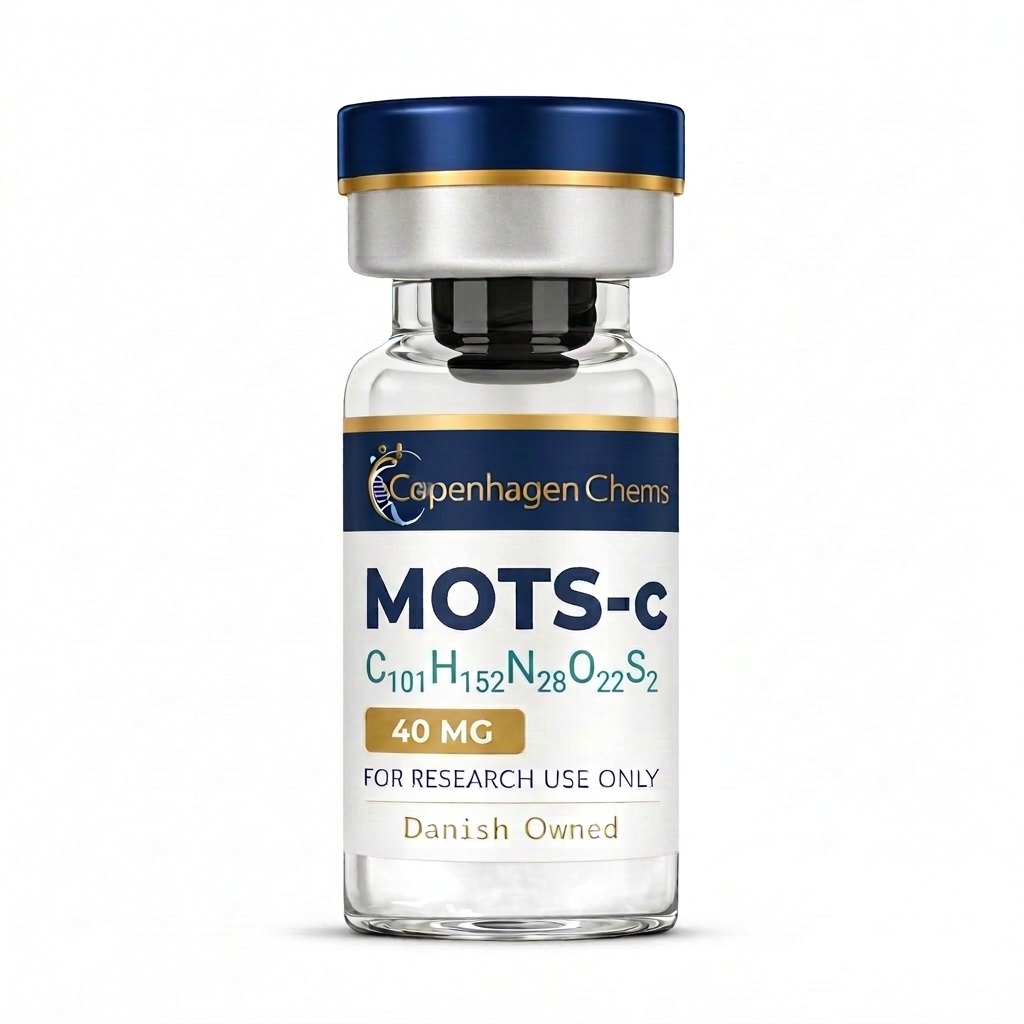
MOTS-c
Mitochondrial Open Reading Frame of the 12S rRNA Type-c
- CAS Number
- 1627580-64-6
- Molecular Weight
- 2174.58 g/mol
- Molecular Formula
- C₁₀₁H₁₅₂N₂₈O₂₂S₂
Sequence
MRWQEMGYIFYPRKLR
Overview
MOTS-c (Mitochondrial Open Reading Frame of the 12S rRNA Type-c) is a 16-amino acid mitochondria-derived peptide (MDP) discovered in 2015 by Dr. Changhan David Lee and colleagues at the University of Southern California. It is encoded within the mitochondrial genome's 12S rRNA gene and represents a novel class of retrograde signaling molecules—peptides produced by mitochondrial DNA that regulate nuclear gene expression. MOTS-c has emerged as a significant molecule in aging and metabolic research, with published studies demonstrating its role as an exercise mimetic and metabolic regulator. Its discovery has expanded understanding of mito-nuclear communication and the role of the mitochondrial genome beyond oxidative phosphorylation.
For research use only · Not FDA/EMA approved · Not for human consumption
Mechanism of Action
Published research describes MOTS-c as activating AMPK (5' adenosine monophosphate-activated protein kinase) through inhibition of the folate-methionine cycle and subsequent accumulation of AICAR (5-aminoimidazole-4-carboxamide ribonucleotide), an endogenous AMPK activator. MOTS-c has been demonstrated to translocate to the cell nucleus under metabolic stress, where it regulates adaptive nuclear gene expression through interaction with antioxidant response elements (ARE). Studies describe effects on fatty acid oxidation, glucose metabolism, insulin sensitivity, and mitochondrial function. MOTS-c's nuclear translocation represents a novel mechanism of mito-nuclear retrograde signaling.
For research use only · Not FDA/EMA approved · Not for human consumption
Key Research Areas
- AMPK activation and metabolic regulation in cellular models
- Exercise mimetic properties and physical performance in aging mice
- Insulin sensitivity and glucose metabolism in diet-induced obesity models
- Mitochondria-nuclear retrograde signaling mechanisms
- Age-related metabolic decline and endogenous MOTS-c levels
- Folate-methionine cycle regulation and one-carbon metabolism
For research use only · Not FDA/EMA approved · Not for human consumption
Published Studies (6 cited)
| Author | Year | Key Finding | Source |
|---|---|---|---|
| Lee C et al. | 2015 | Discovery of MOTS-c as a mitochondria-derived peptide that regulates insulin sensitivity and metabolic homeostasis through AMPK activation. | View paper ↗ |
| Reynolds JC et al. | 2021 | MOTS-c demonstrated exercise-mimetic effects in aged mice, improving physical capacity and healthspan markers when administered late in life. | View paper ↗ |
| Kim KH et al. | 2018 | MOTS-c translocates to the nucleus under metabolic stress to regulate adaptive gene expression, revealing a novel mito-nuclear signaling mechanism. | View paper ↗ |
| Lee C et al. | 2015 | Original report that the mitochondrial-derived peptide MOTS-c promotes metabolic homeostasis and reduces obesity and insulin resistance in mice. | View paper ↗ |
| Kim KH et al. | 2018 | MOTS-c translocates to the nucleus to regulate nuclear gene expression in response to metabolic stress. | View paper ↗ |
| Wan W et al. | 2023 | Review of MOTS-c effects and mechanisms in relation to stress, metabolism and exercise. | View paper ↗ |
For research use only · Not FDA/EMA approved · Not for human consumption
Dosage in Published Research
Published animal studies have administered MOTS-c at doses of 5 mg/kg/day and 15 mg/kg/day via intraperitoneal injection in mouse models. The exercise-mimetic study in aged mice used 15 mg/kg daily for several weeks. In vitro studies have used concentrations of 1–10 μM. All dosing information is from published literature only.
⚠️ Disclaimer: All dosage information is derived exclusively from published scientific literature and is presented for informational reference only. This does not constitute dosing guidance for any application.
For research use only · Not FDA/EMA approved · Not for human consumption
Storage & Handling
Store lyophilized MOTS-c at -20°C or below. Reconstituted solutions should be stored at 2–8°C and used within 7 days. The peptide is sensitive to oxidation; store under inert gas (nitrogen/argon) when possible. Use sterile technique during handling.
For research use only · Not FDA/EMA approved · Not for human consumption
Safety Profile (Literature Only)
MOTS-c is an endogenous mitochondria-derived peptide naturally present in human tissues. Published animal studies have not reported significant adverse effects at investigated doses. As a relatively recently discovered peptide (2015), long-term safety data is limited. No human clinical trial safety data is available. This compound is for laboratory research use only.
For research use only · Not FDA/EMA approved · Not for human consumption
Related Compounds
Retatrutide
A novel triple GIP/GLP-1/glucagon receptor agonist investigated in clinical trials for metabolic research.
LongevityNAD+
An essential coenzyme present in all living cells, investigated for its declining levels with age and role in sirtuin-mediated longevity pathways.
LongevityEpithalon
A synthetic tetrapeptide based on epithalamin, studied for telomerase activation and circadian rhythm modulation in aging research.
For research use only · Not FDA/EMA approved · Not for human consumption