
For research use only · Not FDA/EMA approved · Not for human consumption
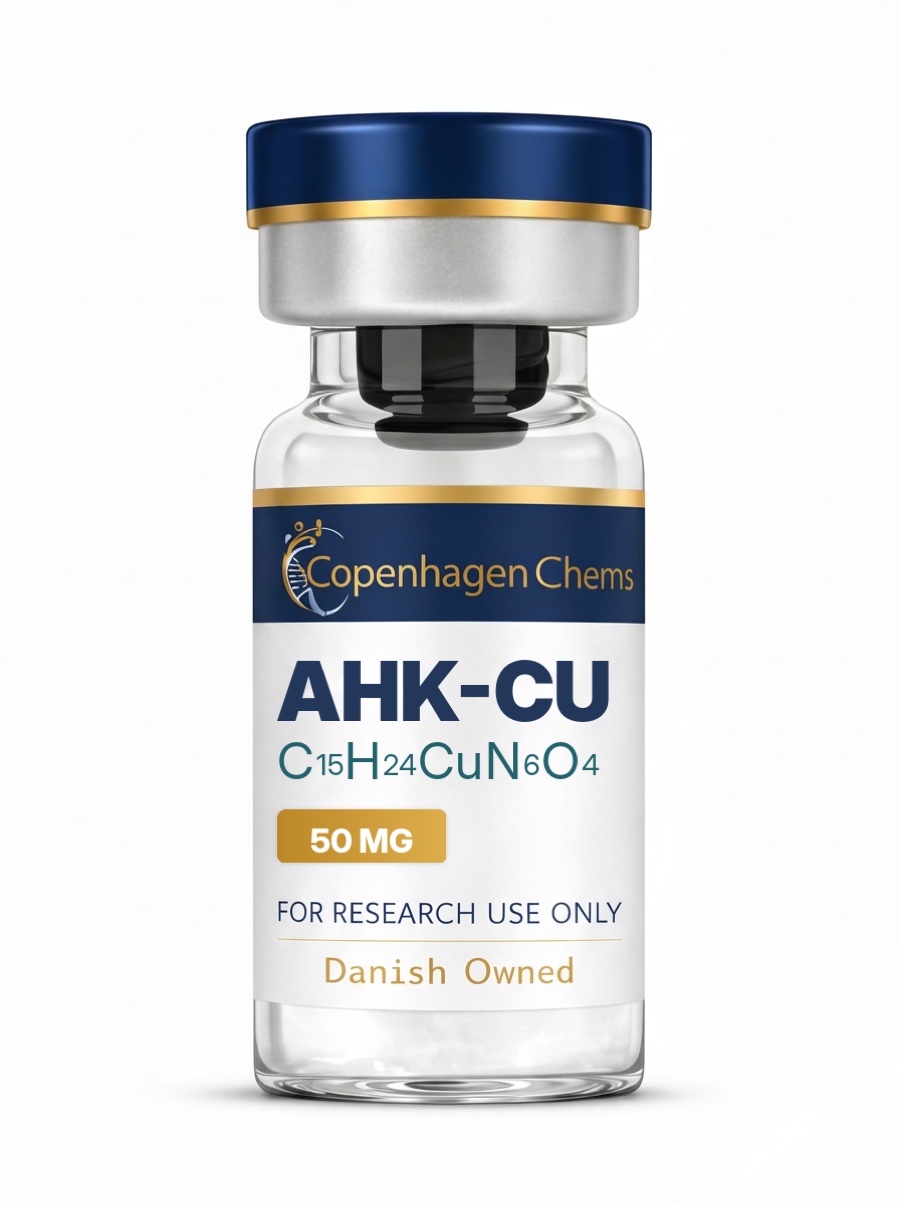
AHK-Cu
Alanyl-histidyl-lysine copper(II) complex
- CAS Number
- 682809-81-0
- Molecular Weight
- 451.39 g/mol
- Molecular Formula
- C₁₅H₂₄ClCuN₆O₄⁻
Sequence
Ala-His-Lys (copper(II) complex)
Overview
AHK-Cu is a copper(II) complex of the tripeptide alanyl-histidyl-lysine. It is structurally adjacent to the much better studied GHK-Cu, differing at the first residue, and both belong to a family of histidine-containing peptides that bind copper with high affinity through the imidazole nitrogen. This entry carries an unusually thin evidence base and we would rather say so than pad it: a search of the indexed biomedical literature returns essentially one primary study on AHK-Cu itself — Pyo and colleagues on human hair growth in vitro — plus structural chemistry on the neighbouring copper-tripeptide complexes. Most material describing AHK-Cu in depth is cosmetic-industry literature that is not peer-reviewed and is not indexed. Readers interested in the copper-peptide mechanism will find far more published work under GHK-Cu, and we link that entry below for that reason. We have chosen to publish this page with two citations rather than assemble a longer list from studies that are not actually about this compound.
For research use only · Not FDA/EMA approved · Not for human consumption
Mechanism of Action
Published work on this specific compound is limited to in vitro observations. Pyo and colleagues reported that a tripeptide-copper complex increased the proliferation of dermal papilla cells and elongation of hair follicles in human hair organ culture, with the reported effect attributed to upregulation of vascular endothelial growth factor. The broader copper-peptide chemistry literature — Hureau and colleagues on the X-ray and solution structures of Cu(II) GHK and Cu(II) DAHK — describes how the coordination geometry of these complexes determines their redox behaviour, which is the property generally proposed to underlie biological activity in this family. Extending that mechanism from GHK-Cu to AHK-Cu is an inference from structural similarity, not something demonstrated for AHK-Cu in published experiments, and this page does not present it as more than that.
For research use only · Not FDA/EMA approved · Not for human consumption
Key Research Areas
- Dermal papilla cell proliferation in human hair organ culture
- Hair follicle elongation in vitro
- VEGF expression as a proposed mediator
- Copper coordination geometry and redox behaviour in histidine-containing tripeptides
- Structural comparison with GHK-Cu and DAHK-Cu
For research use only · Not FDA/EMA approved · Not for human consumption
Published Studies (2 cited)
| Author | Year | Key Finding | Source |
|---|---|---|---|
| Pyo HK et al. | 2007 | A tripeptide-copper complex increased dermal papilla cell proliferation and hair follicle elongation in human hair organ culture in vitro. | View paper ↗ |
| Hureau C et al. | 2011 | X-ray and solution structures of the Cu(II) GHK and Cu(II) DAHK complexes and the influence of coordination geometry on their redox properties — context for the copper-tripeptide family rather than a study of AHK-Cu itself. | View paper ↗ |
For research use only · Not FDA/EMA approved · Not for human consumption
Dosage in Published Research
The available in vitro work applied the complex to cultured cells and organ cultures at micromolar concentrations; no in vivo dosing protocol for AHK-Cu appears in the indexed literature. Because the published record consists of a single primary study on this compound, no dosing range can honestly be characterised as established. All figures are cited from published literature for reference only.
⚠️ Disclaimer: All dosage information is derived exclusively from published scientific literature and is presented for informational reference only. This does not constitute dosing guidance for any application.
For research use only · Not FDA/EMA approved · Not for human consumption
Storage & Handling
Store lyophilized powder at -20°C for long-term storage, protected from light and moisture. Copper peptide complexes are sensitive to pH and to chelating agents; prepare solutions in copper-free buffer. Once reconstituted, store at 2–8°C and use within 14 days. Avoid repeated freeze-thaw cycles. Handle under sterile laboratory conditions using appropriate PPE.
For research use only · Not FDA/EMA approved · Not for human consumption
Safety Profile (Literature Only)
No in vivo toxicity data for AHK-Cu appears in the indexed biomedical literature, and no LD50 has been established. The single primary study is an in vitro investigation and reports no safety endpoints. Any statement about the safety of this compound would go beyond what has been published. This compound is for laboratory research use only.
For research use only · Not FDA/EMA approved · Not for human consumption
Related Compounds
BPC-157
A pentadecapeptide derived from human gastric juice, extensively studied for tissue-protective properties in animal models.
Skin & TissueGHK-Cu
A naturally occurring copper-binding tripeptide studied for its role in tissue remodeling, wound repair, and gene expression modulation.
RecoveryTB-500
A synthetic fragment of thymosin beta-4 researched for actin-binding properties and tissue repair mechanisms in preclinical models.
For research use only · Not FDA/EMA approved · Not for human consumption