
For research use only · Not FDA/EMA approved · Not for human consumption
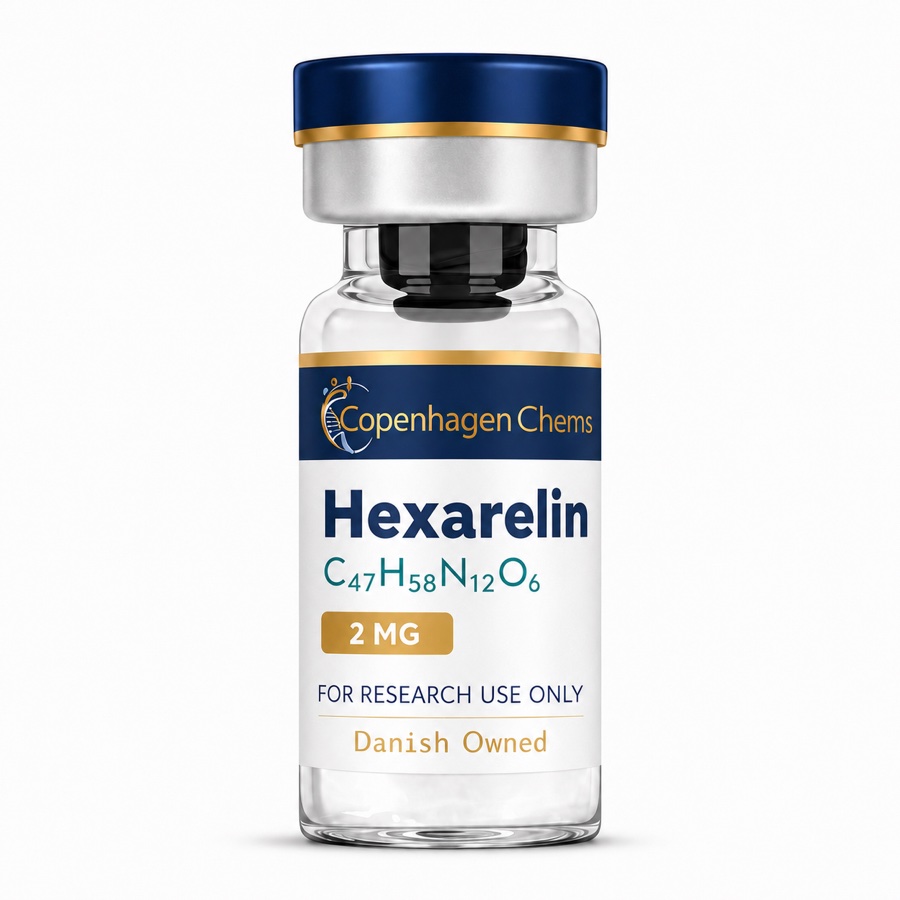
Hexarelin
Hexarelin (Examorelin, HEX)
- CAS Number
- 140703-51-1
- Molecular Weight
- 887.04 g/mol
- Molecular Formula
- C₄₇H₅₈N₁₂O₆
Sequence
His-D-2-Me-Trp-Ala-Trp-D-Phe-Lys-NH₂
Overview
Hexarelin (Examorelin) is a synthetic hexapeptide growth hormone secretagogue (GHS) that acts as a potent agonist at the GHS-R1a (ghrelin receptor). Developed in the 1990s, Hexarelin is one of the most potent GH-releasing peptides studied in clinical settings, producing greater GH release than GHRP-6, GHRP-2, or Ipamorelin. Uniquely, published research has identified cardioprotective effects of Hexarelin that are independent of GH release, mediated through a distinct cardiac receptor (CD36). This dual mechanism has made Hexarelin a particularly interesting research compound in both endocrine and cardiovascular research. Clinical studies have been conducted in healthy subjects, GH-deficient populations, and cardiac patients.
For research use only · Not FDA/EMA approved · Not for human consumption
Mechanism of Action
Hexarelin activates GHS-R1a receptors on pituitary somatotrophs through a mechanism similar to other GHS compounds but with higher potency. Published research describes a unique secondary mechanism: binding to CD36 (scavenger receptor class B, type 3) on cardiac myocytes. CD36-mediated signaling activates PPARγ (peroxisome proliferator-activated receptor gamma) and downstream anti-apoptotic pathways in cardiac tissue, providing GH-independent cardioprotection. Studies describe activation of ERK1/2 and Akt survival signaling in cardiomyocytes. Unlike Ipamorelin, Hexarelin causes some release of cortisol and prolactin at GH-stimulating doses, indicating less receptor selectivity.
For research use only · Not FDA/EMA approved · Not for human consumption
Key Research Areas
- Potent GH release and comparison with other GHS compounds
- CD36-mediated cardioprotection independent of GH axis
- Cardiac function improvement in Phase 2 heart failure trials
- Anti-apoptotic signaling in cardiomyocyte models
- GHS-R1a receptor pharmacology and structure-activity relationships
- PPARγ activation and metabolic effects in cardiac tissue
For research use only · Not FDA/EMA approved · Not for human consumption
Published Studies (6 cited)
| Author | Year | Key Finding | Source |
|---|---|---|---|
| Bisi G et al. | 1999 | Hexarelin demonstrated the most potent GH-releasing activity among hexapeptide secretagogues in healthy human subjects. | View paper ↗ |
| Broglio F et al. | 2002 | Hexarelin improved cardiac performance (increased ejection fraction, decreased systemic vascular resistance) in patients with cardiac dysfunction. | View paper ↗ |
| Locatelli V et al. | 1999 | Hexarelin produced cardioprotective effects in rats that were independent of growth-hormone release. | View paper ↗ |
| Ma Y et al. | 2012 | Hexarelin protected cardiomyocytes from ischemia-reperfusion injury through CD36/PPAR-γ/Akt signaling independent of GH release. | View paper ↗ |
| Ghigo E et al. | 1994 | Dose-response characterization of Hexarelin's GH-releasing activity and comparison of intravenous vs. subcutaneous administration routes. | View paper ↗ |
| Rossoni G et al. | 2000 | Hexarelin protected the isolated rat heart from ventricular dysfunction after ischaemia, independently of growth hormone release. | View paper ↗ |
For research use only · Not FDA/EMA approved · Not for human consumption
Dosage in Published Research
Published clinical studies have used Hexarelin at 1–2 μg/kg intravenously or 20 μg/kg subcutaneously in human studies. Cardiac studies used 20 μg/kg IV. Preclinical studies have employed 100–400 μg/kg in rodent models. Desensitization of GH response has been reported with continuous dosing. All dosing information is from published literature only.
⚠️ Disclaimer: All dosage information is derived exclusively from published scientific literature and is presented for informational reference only. This does not constitute dosing guidance for any application.
For research use only · Not FDA/EMA approved · Not for human consumption
Storage & Handling
Store lyophilized Hexarelin at -20°C. Reconstituted solutions at 2–8°C, use within 14 days. The peptide is stable in solution at neutral pH. Handle with sterile laboratory technique.
For research use only · Not FDA/EMA approved · Not for human consumption
Safety Profile (Literature Only)
Published clinical studies report Hexarelin as generally well-tolerated. Unlike Ipamorelin, Hexarelin does cause some cortisol and prolactin release at GH-stimulating doses. Facial flushing and hunger sensation have been reported. Desensitization of GH response occurs with prolonged continuous use. No serious adverse events have been reported in published clinical studies at investigated doses. This compound is for laboratory research use only.
For research use only · Not FDA/EMA approved · Not for human consumption
Related Compounds
Ipamorelin
A selective growth hormone secretagogue with high GH specificity, investigated for its clean release profile without cortisol or prolactin elevation.
HormonesCJC-1295
A synthetic GHRH analog with extended half-life, researched for sustained growth hormone axis stimulation in clinical settings.
For research use only · Not FDA/EMA approved · Not for human consumption