For research use only · Not FDA/EMA approved · Not for human consumption
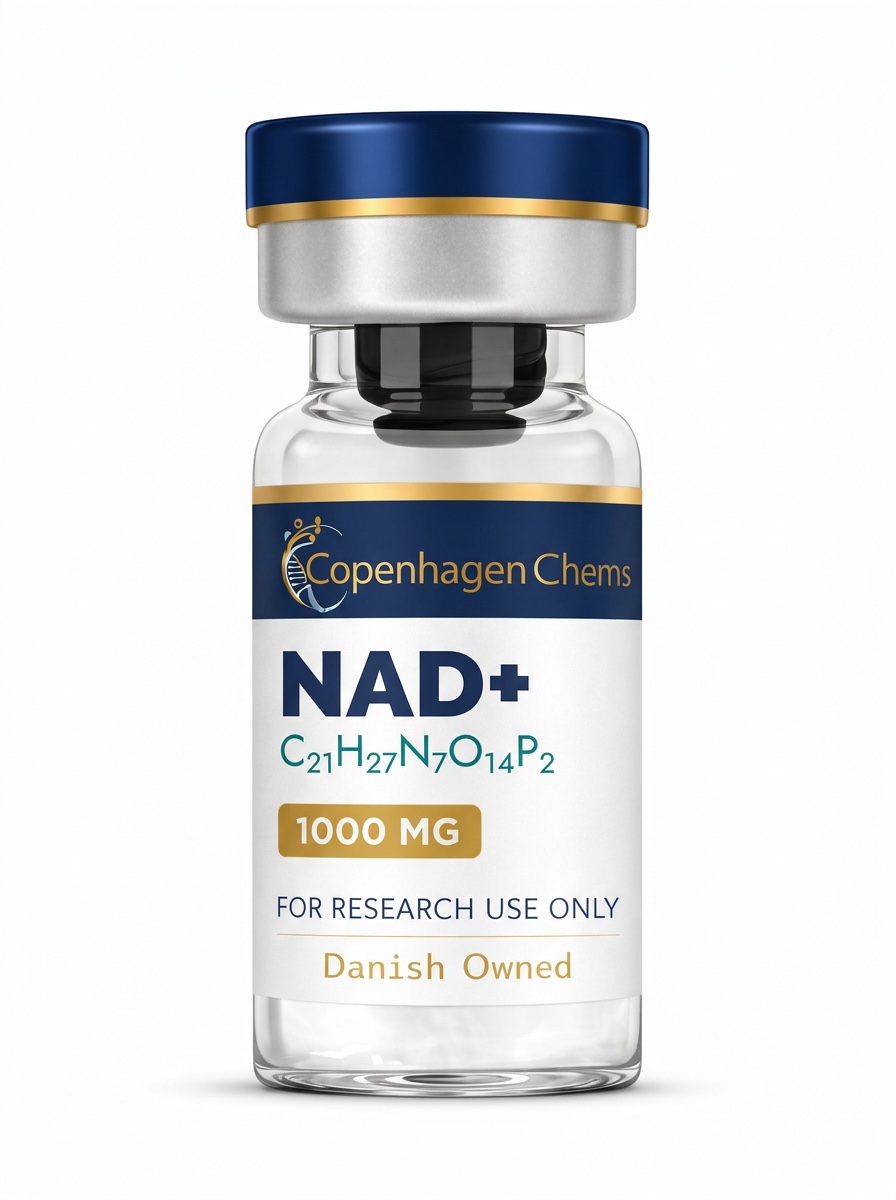
NAD+
Nicotinamide Adenine Dinucleotide (Oxidized Form)
- CAS Number
- 53-84-9
- Molecular Weight
- 663.43 g/mol
- Molecular Formula
- C₂₁H₂₇N₇O₁₄P₂
Overview
Nicotinamide adenine dinucleotide (NAD+) is a fundamental coenzyme found in all living cells, serving as a critical electron carrier in metabolic reactions and as a substrate for NAD+-consuming enzymes including sirtuins (SIRT1-7), poly(ADP-ribose) polymerases (PARPs), and CD38/CD157 ectoenzymes. Published research has established that intracellular NAD+ levels decline significantly with age across multiple organisms and tissues. This age-associated NAD+ decline has been implicated in numerous age-related pathological processes in published literature, driving extensive research into NAD+ biology, NAD+ precursors (NMN, NR), and direct NAD+ supplementation strategies in both preclinical and early clinical settings.
For research use only · Not FDA/EMA approved · Not for human consumption
Mechanism of Action
NAD+ functions as a coenzyme in oxidation-reduction reactions central to cellular energy metabolism (glycolysis, TCA cycle, oxidative phosphorylation). Beyond its role as an electron carrier, NAD+ serves as an obligate substrate for sirtuins—NAD+-dependent protein deacylases that regulate DNA repair, mitochondrial function, inflammatory responses, and metabolic homeostasis. PARP enzymes consume NAD+ during DNA damage repair. CD38, a major NAD+-consuming enzyme, increases with age and has been identified as a key driver of age-related NAD+ decline. Published research describes how restoring NAD+ levels activates SIRT1-mediated pathways including PGC-1α (mitochondrial biogenesis), FOXO (stress resistance), and NF-κB (inflammation regulation).
For research use only · Not FDA/EMA approved · Not for human consumption
Key Research Areas
- Age-related NAD+ decline and its metabolic consequences
- Sirtuin activation and longevity pathway modulation
- Mitochondrial function and biogenesis in aging models
- DNA repair efficiency and genomic stability
- Neurodegeneration and neuroprotection in preclinical models
- Metabolic syndrome and insulin sensitivity research
- CD38 biology and NAD+ consumption pathways
For research use only · Not FDA/EMA approved · Not for human consumption
Published Studies (7 cited)
| Author | Year | Key Finding | Source |
|---|---|---|---|
| Yoshino J et al. | 2018 | Review establishing the connection between NAD+ decline and age-related metabolic dysfunction, proposing NAD+ restoration as a therapeutic strategy. | View paper ↗ |
| Rajman L et al. | 2018 | Comprehensive review of NAD+ biology and therapeutic potential of NAD+ boosting strategies in aging and disease models. | View paper ↗ |
| Camacho-Pereira J et al. | 2016 | Identification of CD38 as a primary driver of age-related NAD+ decline, with CD38 knockout mice maintaining NAD+ levels during aging. | View paper ↗ |
| Verdin E | 2015 | Review of NAD+ as a central metabolic regulator linking cellular metabolism to chromatin state and aging through sirtuin activity. | View paper ↗ |
| Mills KF et al. | 2016 | Long-term NMN administration effectively mitigated age-associated physiological decline in mice, demonstrating NAD+ pathway relevance. | View paper ↗ |
| Gomes AP et al. | 2013 | NAD+ decline impairs mitochondrial function through HIF-1α/c-Myc pathway disruption; NAD+ restoration reversed age-related mitochondrial dysfunction. | View paper ↗ |
| Imai S, Guarente L | 2014 | Proposed the NAD World concept describing systemic regulation of aging through NAD+ biosynthesis and sirtuin activity across tissues. | View paper ↗ |
For research use only · Not FDA/EMA approved · Not for human consumption
Dosage in Published Research
Published NAD+ research utilizes a wide range of concentrations depending on the model system. In vitro studies typically employ 0.1–1 mM NAD+ in cell culture media. Animal studies investigating NAD+ precursors (NMN/NR) have used 100–500 mg/kg/day in rodent models. Direct NAD+ administration studies in animals have used intraperitoneal doses of 100–500 mg/kg. Human clinical trials with NAD+ precursors have investigated 250–2000 mg/day oral doses. All information from published literature only.
⚠️ Disclaimer: All dosage information is derived exclusively from published scientific literature and is presented for informational reference only. This does not constitute dosing guidance for any application.
For research use only · Not FDA/EMA approved · Not for human consumption
Storage & Handling
Store lyophilized NAD+ at -20°C in a desiccated environment. NAD+ is hygroscopic and degrades upon exposure to moisture, heat, and UV light. Reconstituted solutions should be prepared fresh and used within 24 hours. Store reconstituted material at 2–8°C protected from light.
For research use only · Not FDA/EMA approved · Not for human consumption
Safety Profile (Literature Only)
NAD+ is an endogenous molecule essential for life. Published studies on NAD+ precursors (NMN, NR) in human clinical trials have reported generally favorable tolerability profiles at investigated doses. Direct IV NAD+ administration has been investigated in limited clinical settings with reported side effects including nausea and flushing during infusion. Long-term safety data for supraphysiological NAD+ supplementation is limited. This compound is for laboratory research use only.
For research use only · Not FDA/EMA approved · Not for human consumption
Related Compounds
GHK-Cu
A naturally occurring copper-binding tripeptide studied for its role in tissue remodeling, wound repair, and gene expression modulation.
LongevityMOTS-c
A mitochondria-derived peptide (MDP) discovered in 2015, investigated for AMPK activation and metabolic regulation in aging research.
LongevityEpithalon
A synthetic tetrapeptide based on epithalamin, studied for telomerase activation and circadian rhythm modulation in aging research.
Further reading on NAD+
For research use only · Not FDA/EMA approved · Not for human consumption