
For research use only · Not FDA/EMA approved · Not for human consumption
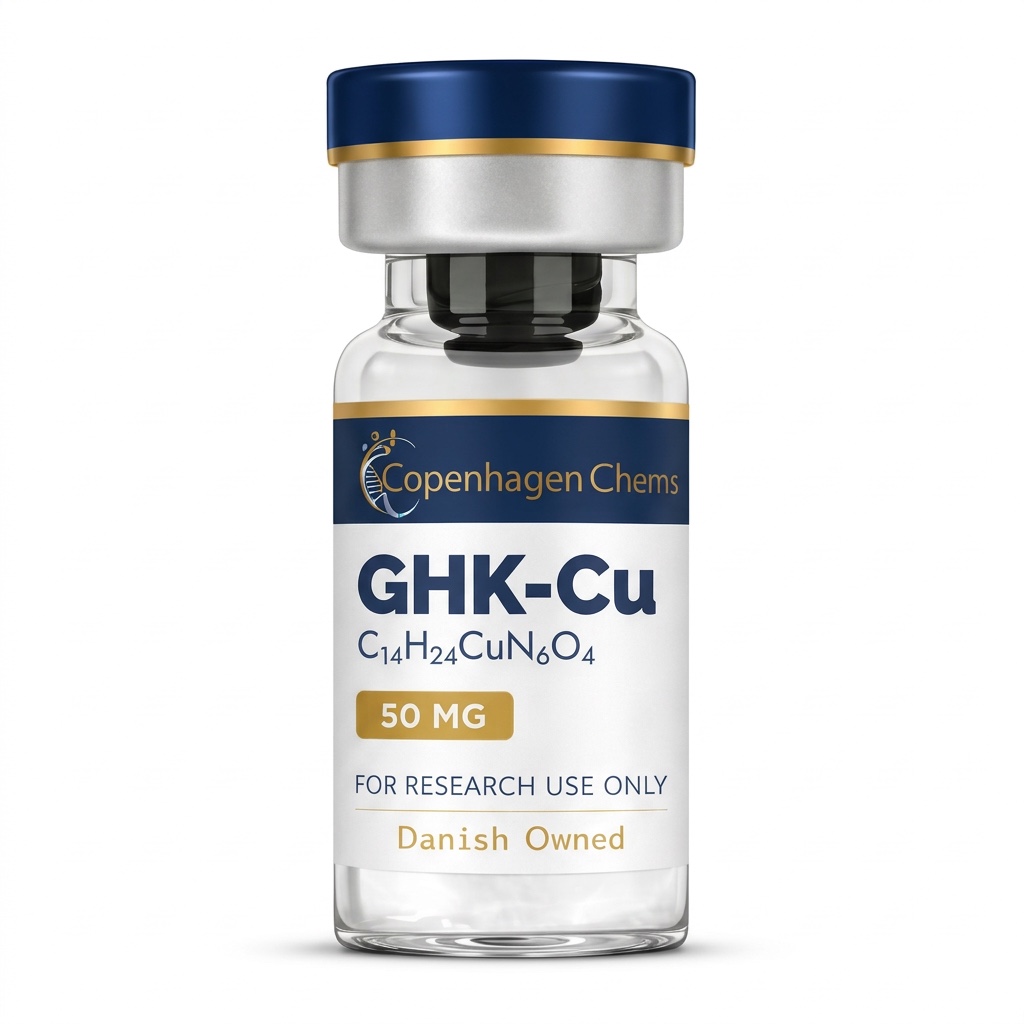
GHK-Cu
Glycyl-L-Histidyl-L-Lysine Copper(II) Complex
- CAS Number
- 49557-75-7
- Molecular Weight
- 403.92 g/mol
- Molecular Formula
- C₁₄H₂₃CuN₆O₄
Sequence
Gly-His-Lys:Cu²⁺
Available in Shop
Overview
GHK-Cu (copper peptide GHK-Cu) is a naturally occurring tripeptide-copper complex first identified in human plasma by Dr. Loren Pickart in 1973. The tripeptide glycyl-L-histidyl-L-lysine has a strong affinity for copper(II) ions and is found in human plasma, saliva, and urine, with plasma concentrations declining with age. GHK-Cu has been the subject of extensive published research spanning over four decades, with studies investigating its effects on wound healing, skin remodeling, anti-inflammatory responses, and gene expression modulation. Gene profiling studies have identified over 4,000 genes whose expression is modulated by GHK-Cu, many involved in tissue repair and regeneration pathways.
For research use only · Not FDA/EMA approved · Not for human consumption
Mechanism of Action
Published research describes GHK-Cu as modulating gene expression through pathways involving transforming growth factor beta (TGF-β), connective tissue growth factor (CTGF), and multiple matrix metalloproteinases (MMPs). The copper complex facilitates delivery of copper(II) ions to cells, which is essential for numerous enzymatic processes including superoxide dismutase activity, lysyl oxidase-mediated collagen cross-linking, and cytochrome c oxidase function. Studies have described stimulation of glycosaminoglycan synthesis, increased decorin production, and modulation of both pro-inflammatory and anti-inflammatory cytokine expression. The peptide's effects on DNA repair gene expression have been documented in microarray studies.
For research use only · Not FDA/EMA approved · Not for human consumption
Key Research Areas
- Wound healing and tissue remodeling in animal and in vitro models
- Collagen and elastin synthesis stimulation in dermal fibroblasts
- Anti-inflammatory gene expression modulation
- Antioxidant enzyme upregulation (SOD, glutathione pathways)
- Hair follicle enlargement and growth cycle modulation
- DNA repair gene activation in gene expression studies
- Bone tissue regeneration and osteoblast differentiation
For research use only · Not FDA/EMA approved · Not for human consumption
Published Studies (7 cited)
| Author | Year | Key Finding | Source |
|---|---|---|---|
| Pickart L et al. | 2012 | Review of GHK-Cu's role in prevention of oxidative stress and degenerative conditions associated with ageing. | View paper ↗ |
| Pickart L, Margolina A | 2018 | Review of GHK-Cu's regenerative and protective actions, documenting effects on DNA repair genes, antioxidant systems, and stem cell markers. | View paper ↗ |
| Pickart L et al. | 2012 | Review of the human tripeptide GHK-Cu in relation to oxidative stress and degenerative conditions of tissue. | View paper ↗ |
| Fu SC et al. | 2015 | The tripeptide-copper complex GHK-Cu(II) transiently improved healing outcome in a rat tendon model. | View paper ↗ |
| Arul V et al. | 2007 | GHK-Cu promoted wound healing in diabetic animal models through enhanced angiogenesis and collagen deposition. | View paper ↗ |
| Hostynek JJ et al. | 2010 | Measured human skin penetration of the copper tripeptide in vitro, quantifying retention across individual skin layers. | View paper ↗ |
| Park JR et al. | 2016 | Study demonstrating GHK-Cu's antioxidant properties and protective effects against oxidative damage in cellular models. | View paper ↗ |
For research use only · Not FDA/EMA approved · Not for human consumption
Dosage in Published Research
In published studies, GHK-Cu has been investigated in various formulations and concentrations. Topical applications in wound healing studies typically used 0.5–2.0 μg/cm² concentrations. In vitro studies have employed concentrations ranging from 1 nM to 10 μM. Injectable formulations in animal studies have used doses in the range of 0.5–10 mg/kg. All dosing information is from published literature only.
⚠️ Disclaimer: All dosage information is derived exclusively from published scientific literature and is presented for informational reference only. This does not constitute dosing guidance for any application.
For research use only · Not FDA/EMA approved · Not for human consumption
Storage & Handling
Store lyophilized GHK-Cu at -20°C protected from light and moisture. The copper complex is photosensitive. Reconstituted solutions should be stored at 2–8°C and used within 7 days. Use sterile technique during handling.
For research use only · Not FDA/EMA approved · Not for human consumption
Safety Profile (Literature Only)
GHK-Cu is a naturally occurring compound in human plasma. Published toxicology studies have not reported significant adverse effects at concentrations studied. The peptide has been used in wound care and cosmetic formulations in applied settings. No adverse effects have been reported in published preclinical studies at investigated doses. This compound is sold for laboratory research use only.
For research use only · Not FDA/EMA approved · Not for human consumption
Related Compounds
BPC-157
A pentadecapeptide derived from human gastric juice, extensively studied for tissue-protective properties in animal models.
RecoveryTB-500
A synthetic fragment of thymosin beta-4 researched for actin-binding properties and tissue repair mechanisms in preclinical models.
LongevityEpithalon
A synthetic tetrapeptide based on epithalamin, studied for telomerase activation and circadian rhythm modulation in aging research.
For research use only · Not FDA/EMA approved · Not for human consumption