
For research use only · Not FDA/EMA approved · Not for human consumption
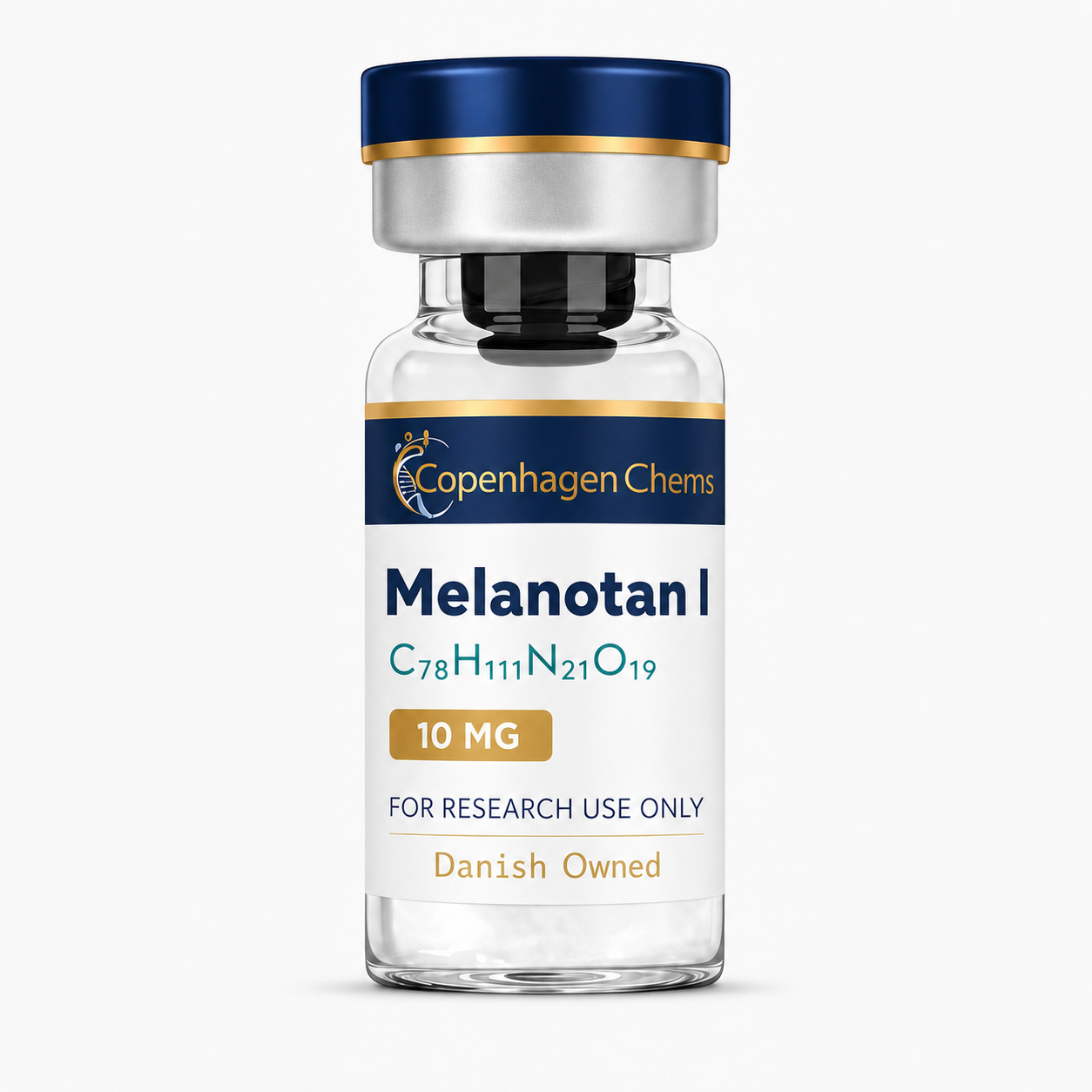
Melanotan-I
Afamelanotide (Melanotan-I, NDP-α-MSH)
- CAS Number
- 75921-69-6
- Molecular Weight
- 1646.8 g/mol
- Molecular Formula
- C₇₈H₁₁₁N₂₁O₁₉
Sequence
13-amino-acid linear analogue of α-MSH (Nle⁴, D-Phe⁷ substitutions)
Overview
Melanotan-I, known generically as afamelanotide, is a 13-amino-acid linear analogue of alpha-melanocyte-stimulating hormone in which two substitutions — norleucine at position 4 and D-phenylalanine at position 7 — confer substantially greater metabolic stability and receptor potency than the native hormone. It should not be confused with melanotan-II, a different, cyclic compound with a broader melanocortin receptor profile. Afamelanotide is distinguished within this peptide family by having a completed randomised controlled trial published in the New England Journal of Medicine, in the rare inherited photosensitivity disorder erythropoietic protoporphyria, and by having subsequently received regulatory approval for that specific indication.
For research use only · Not FDA/EMA approved · Not for human consumption
Mechanism of Action
Published pharmacology describes afamelanotide as a potent agonist at the melanocortin-1 receptor (MC1R) expressed on melanocytes. MC1R activation is described in the literature as stimulating the cAMP pathway and upregulating tyrosinase, the rate-limiting enzyme in melanin synthesis, shifting production toward eumelanin. The published rationale for its investigation in erythropoietic protoporphyria is that increased eumelanin content provides photoprotection, reducing the phototoxic reactions that characterise that condition. The Nle⁴ and D-Phe⁷ substitutions are described as conferring resistance to enzymatic degradation, giving a considerably longer duration of action than native α-MSH.
For research use only · Not FDA/EMA approved · Not for human consumption
Key Research Areas
- Randomised controlled trial in erythropoietic protoporphyria
- MC1R agonism and eumelanin synthesis
- Photoprotection and phototoxicity endpoints
- Structure-activity relationships of α-MSH analogues
- Pharmacology of the melanotropic peptide family
For research use only · Not FDA/EMA approved · Not for human consumption
Published Studies (4 cited)
| Author | Year | Key Finding | Source |
|---|---|---|---|
| Langendonk JG et al. | 2015 | Randomised controlled trial of afamelanotide in patients with erythropoietic protoporphyria. | View paper ↗ |
| Kim ES et al. | 2016 | Review of afamelanotide in erythropoietic protoporphyria, summarising the efficacy and safety evidence. | View paper ↗ |
| Minder EI et al. | 2015 | Review of afamelanotide (CUV1647) in the dermal phototoxicity of erythropoietic protoporphyria. | View paper ↗ |
| Langan EA et al. | 2010 | Review of the melanotropic peptides, including discussion of their unregulated use and the clinical concerns arising from it. | View paper ↗ |
For research use only · Not FDA/EMA approved · Not for human consumption
Dosage in Published Research
The published clinical trials of afamelanotide in erythropoietic protoporphyria used a 16 mg subcutaneous controlled-release implant administered at approximately two-monthly intervals, rather than repeated injections. This is a formulation and schedule specific to that indication and trial programme. All dosing information is reported from published clinical literature for reference purposes only.
⚠️ Disclaimer: All dosage information is derived exclusively from published scientific literature and is presented for informational reference only. This does not constitute dosing guidance for any application.
For research use only · Not FDA/EMA approved · Not for human consumption
Storage & Handling
Store lyophilized powder at -20°C for long-term storage, protected from light and moisture. Once reconstituted, store at 2–8°C and use within 14 days. Avoid repeated freeze-thaw cycles. Handle under sterile laboratory conditions using appropriate PPE.
For research use only · Not FDA/EMA approved · Not for human consumption
Safety Profile (Literature Only)
Published trial data report nausea, headache and generalised skin darkening among the effects observed. The published dermatological literature raises a distinct and important concern about melanotropic peptides used outside clinical supervision: because MC1R agonism darkens existing melanocytic lesions, changes in naevi that would otherwise prompt clinical assessment may be masked or altered. The approved clinical use of afamelanotide is confined to a specific rare indication under specialist supervision. This compound is supplied for laboratory research use only.
For research use only · Not FDA/EMA approved · Not for human consumption
Related Compounds
GHK-Cu
A naturally occurring copper-binding tripeptide studied for its role in tissue remodeling, wound repair, and gene expression modulation.
Skin & TissueAHK-Cu
A copper-binding tripeptide closely related to GHK-Cu, studied chiefly in vitro for effects on dermal papilla cells and hair follicle growth.
HormonesPT-141
A cyclic melanocortin receptor agonist derived from α-MSH, investigated in controlled clinical trials for sexual arousal endpoints.
For research use only · Not FDA/EMA approved · Not for human consumption